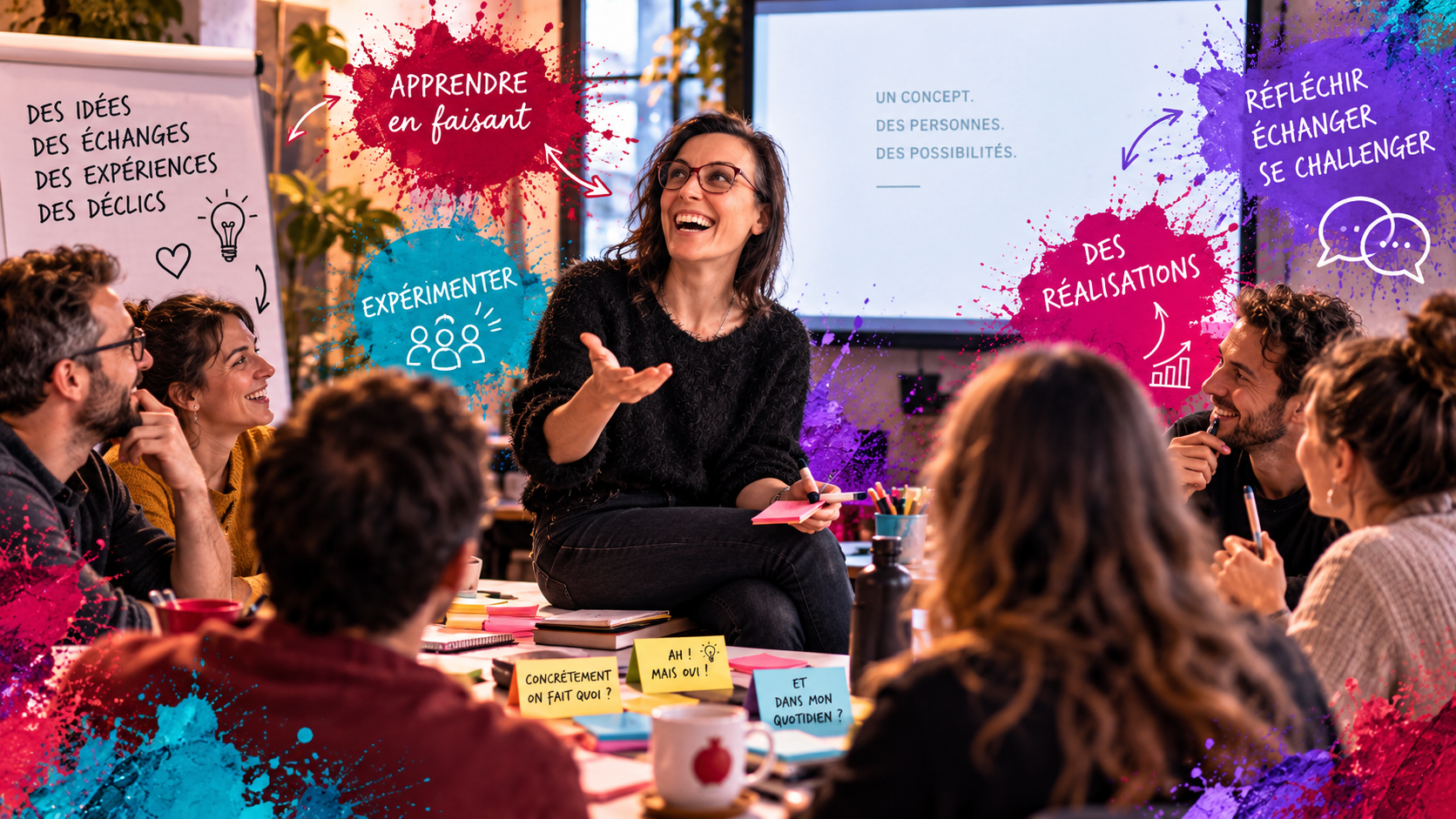
I have probably never felt quite as at home as I do in a training room.
Give me a small group, a table I can sit on while talking with participants, a few markers, a whiteboard, some Post-it notes and a topic, with enough freedom to build a learning experience… and there is a very good chance I will turn it into something fascinating because…
Training is where I feel at home.
Because what I love about professional training is not so much passing on information.
Information is everywhere.
What I love is seeing the moment when it becomes understanding.
That little:
“Aaaaah… yes, of course!”
The moment when someone understands something about themselves, about other people, about their work or about a situation they have been dealing with for years.
When someone leaves with a better understanding of what surrounds them and, above all, able to use what they have just learned, I get that delicious feeling of:
“job done.”
Training should not be about swallowing information
I am probably going to make a few “friends” in the industry with this one.
You know that training course.
9:03 a.m.
PowerPoint.
Slide no. 1.
The trainer reads the slide.
Slide no. 2.
The trainer reads that one too.
By 10:17 a.m., your soul has left your body, but your physical presence remains compulsory until 5 p.m.
I have been there too.
Even when I was younger, I had very little patience for being asked simply to absorb information and then reproduce it.
Because learning is not just memorising. It is understanding. Questioning. Connecting new information to what we already know. Experiencing it. Testing it. Sometimes even challenging it.
Good training should call on participants’ judgement, critical thinking and ability to reflect.
Otherwise, you might as well send the PDF. Attending will be about as productive as skimming it.
Active learning: making learners active participants in their training
That is why I particularly enjoy active learning approaches and participatory training.
I can introduce a concept, of course. Explain it. Put it into context. Provide the knowledge needed to understand it. But then I want us to do something with it. An exercise. An experiment. A game. A discussion, perhaps even a debate. A case study. A problem to solve. A role-play. Small-group work.
A deliberately exaggerated situation in which people can test a behaviour without facing the consequences it might have in real life.
Because there is an enormous difference between:
“I know intellectually how to manage a conflict.”
and:
“I have just tried to manage a conflict.” (and it went well…)
It is in that space between knowledge and experience that training becomes truly interesting.
Role-play: experimenting without risking breaking the machine
Take conflict management in the workplace, for example. (One of the training topics I often work on with clients. I wonder why.)
We could quite easily spend two hours explaining the mechanics of conflict, perception biases, possible reactions and communication techniques.
All of that can be useful.
But it is still theory. So I like to introduce role-play and practical scenarios.
Sometimes deliberately extreme ones. Or spaces where people can practise making mistakes.
By exaggerating a behaviour, playing a role or deliberately pushing a situation towards the absurd, we can experiment. Try. Fail. Start again. Observe what happens. Try something more daring or more personal. And laugh. Laughter does not prevent learning. Quite the opposite.
Laughter can create a space in which we dare to try more, make mistakes and step outside our usual patterns.
We can work seriously without taking ourselves seriously all the time.
Learning workshops that also create connection
That is another thing I love about training.
A training room is not simply a collection of individuals who have come to acquire a skill.
For a while, it is also a group.
And that group can become a learning resource for its members.
A well-designed icebreaker is not just a way of making fifteen people say their name and favourite animal.
It can immediately create a dynamic.
Reveal differences.
Allow participants to discover their colleagues in a different way.
Encourage cooperation.
Create enough psychological safety for someone to dare to say:
“I didn’t understand.”
or:
“I disagree.”
From a learning perspective, those two sentences are worth their weight in gold.
Because a training session where nobody ever questions anything is not necessarily a training session everyone has perfectly understood. It may simply be a room that is far too polite.
Designing bespoke training instead of applying a ready-made formula
I also design bespoke training programmes and learning workshops.
And “bespoke” does not mean changing the logo on the first slide.
It means starting by understanding:
Who are the participants?
What do they already know?
What do they actually need to learn?
In what situations will they need to use this knowledge?
What are the learning objectives?
What difficulties are they encountering?
What skills do we want to develop?
How much time is available?
What is likely to bore them?
What, on the contrary, might put them in difficulty?
How will we know, at the end, whether something has actually been learned?
This is instructional design at a very practical level: starting with the need and building the learning experience around it, rather than starting with a nice set of slides and hoping very hard that something happens.
Already have a training programme? Perfect. We can strengthen it too.
And this is a part of my work that I particularly enjoy.
You may already have what you believe is an excellent training programme.
The content is relevant. The expertise is there. But…
it is a little flat. Lots of slides. Lots of theory. Lots of time spent listening. And after an hour and a half, you notice that very particular look on the participants’ faces. The one that tells you their bodies are still in the room, but their brains have gone out to buy bread.
That is precisely where I can step in.
Not necessarily to rebuild your entire training programme, don’t worry.
But to design learning activities that strengthen existing content.
Turn twenty minutes of theory into an inspiring workshop. Create a practical scenario. Imagine a game that lets people experience a concept. Build a case study. Add an individual reflection exercise. Get participants working together. Create a sequence that checks what has actually been understood.
In short:
put some movement into the content.
What about online training?
Same problem.
Changing the medium does not magically transform a lecture into a learning experience.
Online training can be excellent, but it still demands motivation to listen and participate. And those little practical exercises people are asked to complete can sometimes feel more paralysing than encouraging.
It can also become:
video 1, video 2, questionnaire, video 3, quiz, congratulations, you have finished.
And three weeks later:
“What was that about again?”
For e-learning, I can therefore also design intermediate exercises intended to maintain engagement and consolidate learning.
Reflection questions. Practical cases. Application exercises. Challenges between two modules. Activities that require learners to use a concept in a real situation.
Tools for assessing learning outcomes. Sequences that revisit previous knowledge.
Because finishing a video does not necessarily mean you have learned something.
Consuming content is not the same as learning it.
Consolidating learning rather than simply “completing the course”
There is a distinction that seems fundamental to me between:
having attended a training course
and
having acquired a skill.
A ticked box on an LMS platform tells us that someone reached the end of a module.
It does not necessarily tell us what they will know how to do on Monday morning.
So I like working on learning consolidation.
Bring a concept back.
Present it from another angle.
Ask people to use it.
Introduce a new difficulty.
Check whether someone can transfer what they have just learned to a different situation.
And, above all, allow people to make mistakes.
Because mistakes in training are wonderful.
They allow us to discover precisely what has not yet been understood before the mistake actually costs something.
Training in human relationships: an especially rich field
My favourite field remains, of course, human relationships.
Communication.
- Conflict management.
- Management.
- Workplace relationships.
- Professional stance.
- Understanding individual ways of functioning.
- Cooperation.
- Relational intelligence.
I have also designed and facilitated training around Human Design, including relational workshops that allow participants not only to discover their profile but also to experience what these differences can produce in their interactions.
And this is where my different activities come together.
Coaching has taught me how to ask questions.
Training forces me to structure and communicate.
My work on relationships allows me to observe what happens between participants, not only what is written in my training programme.
The best training may be the one where the trainer talks less
That may sound paradoxical when you sell training.
But I have no desire to be the person showing off for seven hours.
My role is also to create the conditions that allow participants to think for themselves.
I can bring expertise.
I can create the framework.
I can challenge an answer.
Add information.
Put two ideas into conflict.
Point out something that has just happened within the group.
But participants also arrive with their own experiences, skills, disagreements and questions.
Why waste all that richness by simply asking them to shut up and listen to me?
Training is not about filling heads. It is about creating the conditions for something to be built inside them.
And sometimes between them.
Why do I train people?
Ultimately, for that moment.
The one when someone stops.
Thinks.
And says:
“Wait… I’ve just understood something.”
I love that moment.
Because a piece of information has just changed status.
It is no longer simply something I said.
It now belongs to the person who has understood it.
And when a workshop has also allowed several people to laugh together, understand each other better, test something they would never have dared to try in their professional environment and leave with a skill they can genuinely use…
Yes.
That is when I feel I have done my job.
Looking for professional training or a bespoke workshop?
I can work with you in several ways:
- design and deliver bespoke professional training;
- create a learning or participatory workshop around a specific issue;
- contribute to an existing seminar or training programme;
- design an icebreaker with a genuine purpose rather than simply an entertainment effect;
- create games, case studies and professional role-play scenarios;
- enrich an existing training programme with active learning activities;
- design exercises for online training or e-learning to support attendance, engagement and consolidation of learning;
- work on communication, management, cooperation, human relationships or conflict management in the workplace.
Already have the content but it lacks the learning experience? I am interested in that too. Without adding another 50 slides, don’t worry: together, we can absolutely make sure that something happens in the room.