
Catégorie : public speaking

  • Public speaking: what if you learned to speak like a politician… but actually had something to say?

    Public speaking: what if you learned to speak like a politician… but actually had something to say?

    You know those people who stand up and speak in front of an entire room, a microphone or a camera?

    Yes, yes. Those politicians who can spend ten minutes developing an idea that could sometimes have fit into three sentences.

    And yet, we listen to them.

    The sentence is perfectly constructed. The pace is controlled. The pauses land in exactly the right places. Their gaze sweeps across the room. Their voice drops when a statement needs weight and rises when they need to carry the audience with them.

    In short: even when the substance fails to convince us, the form of public speaking can be remarkably well mastered.

    What if this skill were not reserved for politicians, keynote speakers and those other mysterious creatures who somehow enjoy finding themselves in front of 800 people?

    Because before dreaming of giving a TED Talk, learning to speak with confidence can be useful in far more ordinary situations.

    Presenting an idea in a meeting. Defending a project. Going to a job interview. Asking for a raise. Explaining to a client why you disagree with them. Or diplomatically telling your boss that their wonderful idea may be sending everyone straight into a wall.

    Public speaking is about being convincing, but it is also about learning to defend your place and your ideas.

    What exactly is public speaking?

    It is easy to picture a lectern, a stage and a crowd.

    But public speaking more broadly means speaking to an audience. In its oratorical sense, a speech is a developed statement delivered before a group of people; public speaking involves structured and intentional communication designed, among other things, to inform or persuade. Le Robert

    And that “audience” can perfectly well consist of eight colleagues around a table.

    As soon as you need to organise your thoughts, capture attention, convey information and perhaps persuade several people, you are already using some of the skills involved in public speaking.

    The good news is that these skills can be learned.

    Speaking well in public is not just about finding the right words

    We place enormous importance on words, or more precisely on the script.

    We think we need to prepare it, write it, rewrite it… that we need to create a magnificent 47-slide presentation that we will then inflict on innocent people.

    And we forget the fundamental thing:

    a speech is not made of words alone. It is, and should be, embodied.

    Take a perfectly ordinary sentence:

    “I think we should reconsider this decision.”

    Say it quickly, looking down, shoulders hunched and voice hesitant.

    Then say exactly the same sentence while looking at the other person, slowing your pace slightly and leaving a second of silence after “decision”.

    Same sentence.

    Not the same speech.

    Your voice, rhythm, pauses, breathing, eye contact and posture all shape the way your message is received.

    Eloquence is not a gift reserved for a lucky few

    Some people seem naturally comfortable when they have to speak in public.

    That does not mean they were born holding a microphone.

    A large part of speaking with ease comes from skills that can be developed: structuring an idea, articulating your reasoning, using your voice, managing your pace, looking at your audience, mastering your posture and, above all, learning to tolerate that particularly delightful sensation of having twenty pairs of eyes fixed on you.

    Because behind difficulty speaking up, there is often something else:

    fear of judgement.

    “What if I stumble over my words?”

    “What if my mind goes blank?”

    “What if someone contradicts me?”

    “What if my question is stupid?”

    “What if I am not legitimate enough to speak?”

    Self-confidence in public speaking does not necessarily mean eliminating stage fright.

    It is more about developing enough inner security to speak despite it.

    Speaking up in meetings: public speaking in miniature

    This is probably one of the situations where the skill becomes most concrete.

    Picture the scene: you are in a meeting. A decision is about to be made. And you sincerely believe it is a bad one.

    You now have several options.

    • Stay silent and complain magnificently by the coffee machine an hour later.
    • Blurt out:

    “Honestly, this is never going to work.”

    • Or learn to express disagreement clearly, diplomatically and convincingly.

    For example, by structuring your intervention:

    here is what I observe → here is the risk I see → here is why → here is the alternative I propose.

    That way, you are no longer merely expressing an opinion. You are building an argument. That is already rhetoric.

    And knowing how to speak up in meetings can considerably change the way your skills and ideas are perceived professionally.

    Defending your interests without turning into a pushy salesperson

    Public speaking is not only useful for presenting projects.

    It also helps you defend your interests.

    Take the wonderful human experience of asking for a raise.

    Walking into your manager’s office with:

    “Er… I’ve been here for quite a while now and I was thinking maybe we could perhaps talk about my salary…”

    does not have the same effect as calmly presenting:

    what you have achieved, the responsibilities you carry, the value you bring and the precise request you are making.

    Asking for a raise is also an exercise in public speaking and argumentation.

    It is neither about attacking nor begging.

    It is about building a message clear enough for the other person to know exactly what you are asking for and why.

    A successful job interview is also about knowing how to tell a story

    The same mechanism applies in a job interview.

    We often imagine that answering the questions correctly is enough.

    But a recruiter only has a few dozen minutes to understand who you are professionally.

    Your ability to present your career path, explain your choices, tell the story of an experience, give a concrete example and respond calmly to an objection therefore becomes essential.

    Saying:

    “I know how to handle difficult situations”

    is a claim.

    Telling, in forty seconds, the story of a difficult situation, what you did and what happened next is a demonstration.

    And our brains like stories.

    Knowing how to speak in public therefore also means learning to turn a succession of information into an intelligible story.

    How do you make a presentation interesting without delivering a pompous TED Talk?

    Ah, the famous TED Talk.

    The black stage. The red circle. The little personal anecdote. The dramatic pause. And sometimes that strange feeling that someone is about to reveal the secret of the universe using three sticky notes and an experience they once had in an airport (I’m barely exaggerating…).

    Still, the format reminds us of something useful:

    a good presentation is not an accumulation of information.

    It has a direction.

    To prepare an interesting oral presentation, start with an extremely simple question:

    What do I want the people in the room to understand, feel or do after listening to me?

    One main idea.

    Then build around it.

    An opening that makes people want to listen.

    A clearly stated problem.

    A few arguments or examples.

    A progression.

    And a conclusion that genuinely answers the question you started with.

    You have just created a mini TED Talk.

    Without necessarily pacing slowly across a stage while explaining how meeting a Peruvian llama transformed your understanding of leadership.

    Posture matters… but it should not become theatre

    “Stand up straight.”

    “Look at your audience.”

    “Use your hands when you speak.”

    All of this advice can be useful.

    Until you spend so much time controlling your body that you start to look like a mime in the middle of an experimental workshop.

    The goal is not to manufacture an artificial posture of confidence.

    It is rather to remove what interferes with your message.

    Breathe enough.

    Do not speak at breakneck speed.

    Accept pauses.

    Actually look at the people you are speaking to.

    Take up your space instead of trying to disappear.

    Good posture supports the speech; it does not perform the speech for you.

    What if I freeze when I have to speak in public?

    Stage fright before speaking in public is not a sign that you lack competence in your field, only that public speaking itself may be a skill you still need to develop.

    The main challenge is to prevent the emotion from taking complete control of your attention.

    And one of the most effective methods remains spectacularly unglamorous:

    prepare and rehearse. (yes, with a Coach, it’s even better…)

    Not memorise every sentence word for word.

    Know your structure well enough to know where you are going even if a particular phrase escapes you.

    Prepare especially:

    your opening sentence, your three main ideas, your transitions, and your final sentence.

    Then you no longer need to retrieve a script from memory.

    You simply find your way again.

    Persuasion is not manipulation

    This is a distinction that matters to me.

    Developing eloquence and persuasive ability does not mean learning how to manipulate other people.

    An argument can perfectly well respect the freedom of the person listening.

    You set out your reasoning. You make your idea understandable. You explain why you defend it. You give the other person reasons to follow you.

    And they remain perfectly entitled to answer:

    “No.”

    Learning to persuade should therefore also mean learning to listen, respond to objections and accept disagreement.

    Otherwise, it is not really an exchange anymore.

    It is a monologue with a witness.

    Can public speaking be learned?

    Yes.

    And above all, you do not need to dream of becoming a professional speaker.

    You can work on your public speaking simply so that you can say clearly what you think when it matters.

    Speak up more often in meetings.

    Present your work without apologising for existing.

    Defend an idea in front of your team.

    Go into job interviews with greater confidence.

    Ask for a raise without wanting to disappear under the table.

    Set a boundary.

    Respond to an objection.

    Present a project.

    Or simply manage to say:

    “I disagree, and here is why.”

    Perhaps that is ultimately the interesting skill behind public speaking.

    Not becoming someone who can talk for twenty minutes without saying anything.

    But becoming someone capable of saying something when their voice matters.

    Public speaking is also about learning to defend your place and your ideas.

    Working on public speaking through coaching

    Public speaking is particularly interesting territory for coaching because it combines several dimensions: self-confidence, communication, stress management, posture, argumentation, the ability to defend your interests and your relationship with other people’s judgement.

    So we can work very concretely.

    Prepare a presentation. Simulate an interview. Rehearse asking for a raise. Work through a difficult intervention in a meeting. Test several formulations. Observe what a different posture changes. Learn how to respond when someone interrupts or contradicts you.

    Because between intellectually understanding how good public speaking works and actually doing it in front of someone, there is a particularly interesting little space:

    practice.

    And that is precisely where we can start playing — and you know how much I love to play…
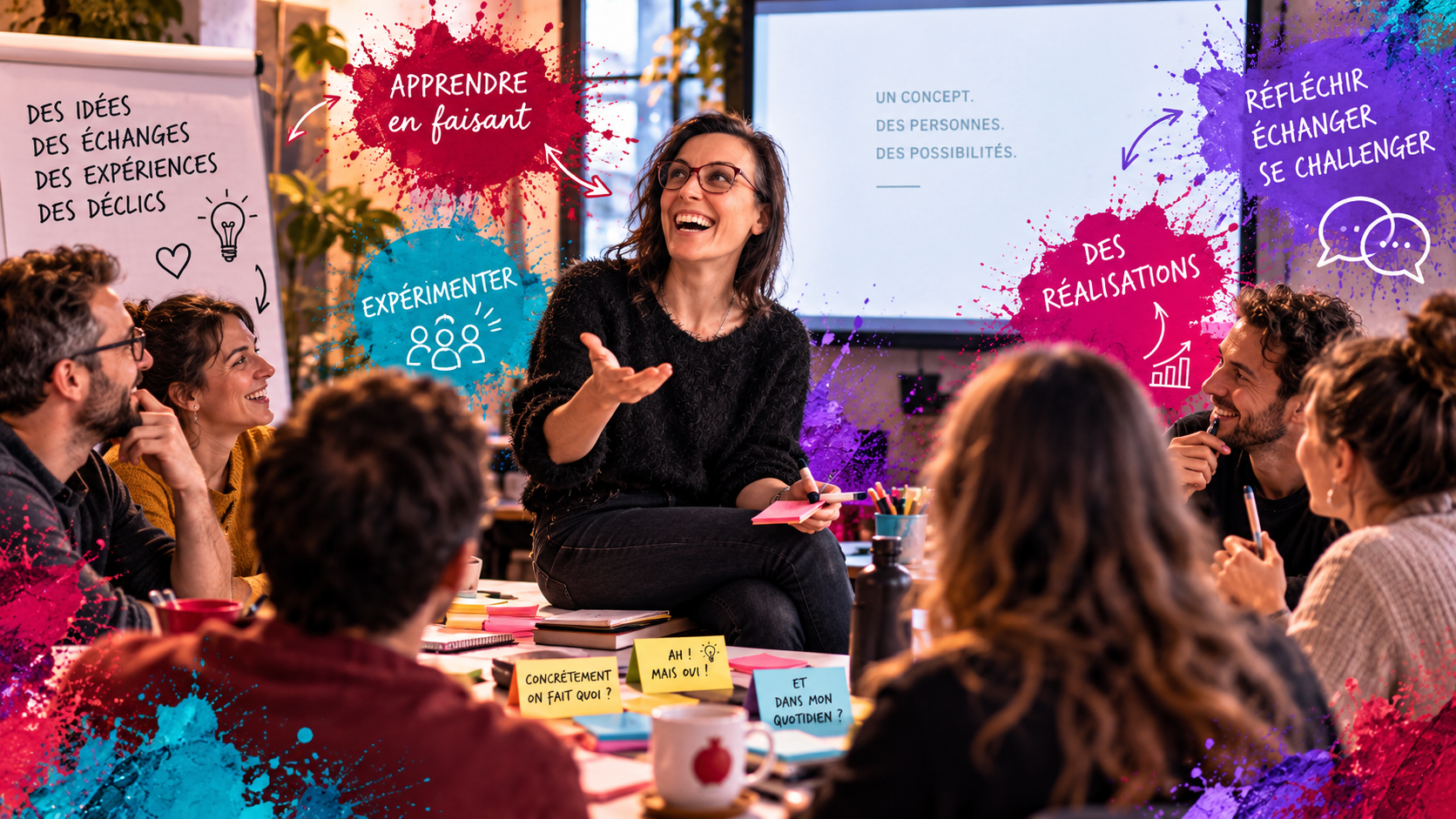
  • Bespoke professional training: learn, experiment… and even have fun

    Bespoke professional training: learn, experiment… and even have fun

    I have probably never felt quite as at home as I do in a training room.

    Give me a small group, a table I can sit on while talking with participants, a few markers, a whiteboard, some Post-it notes and a topic, with enough freedom to build a learning experience… and there is a very good chance I will turn it into something fascinating because…

    Training is where I feel at home.

    Because what I love about professional training is not so much passing on information.

    Information is everywhere.

    What I love is seeing the moment when it becomes understanding.

    That little:

    “Aaaaah… yes, of course!”

    The moment when someone understands something about themselves, about other people, about their work or about a situation they have been dealing with for years.

    When someone leaves with a better understanding of what surrounds them and, above all, able to use what they have just learned, I get that delicious feeling of:

    “job done.”

    Training should not be about swallowing information

    I am probably going to make a few “friends” in the industry with this one.

    You know that training course.

    9:03 a.m.

    PowerPoint.

    Slide no. 1.

    The trainer reads the slide.

    Slide no. 2.

    The trainer reads that one too.

    By 10:17 a.m., your soul has left your body, but your physical presence remains compulsory until 5 p.m.

    I have been there too.

    Even when I was younger, I had very little patience for being asked simply to absorb information and then reproduce it.

    Because learning is not just memorising. It is understanding. Questioning. Connecting new information to what we already know. Experiencing it. Testing it. Sometimes even challenging it.

    Good training should call on participants’ judgement, critical thinking and ability to reflect.

    Otherwise, you might as well send the PDF. Attending will be about as productive as skimming it.

    Active learning: making learners active participants in their training

    That is why I particularly enjoy active learning approaches and participatory training.

    I can introduce a concept, of course. Explain it. Put it into context. Provide the knowledge needed to understand it. But then I want us to do something with it. An exercise. An experiment. A game. A discussion, perhaps even a debate. A case study. A problem to solve. A role-play. Small-group work.

    A deliberately exaggerated situation in which people can test a behaviour without facing the consequences it might have in real life.

    Because there is an enormous difference between:

    “I know intellectually how to manage a conflict.”

    and:

    “I have just tried to manage a conflict.” (and it went well…)

    It is in that space between knowledge and experience that training becomes truly interesting.

    Role-play: experimenting without risking breaking the machine

    Take conflict management in the workplace, for example. (One of the training topics I often work on with clients. I wonder why.)

    We could quite easily spend two hours explaining the mechanics of conflict, perception biases, possible reactions and communication techniques.

    All of that can be useful.

    But it is still theory. So I like to introduce role-play and practical scenarios.

    Sometimes deliberately extreme ones. Or spaces where people can practise making mistakes.

    By exaggerating a behaviour, playing a role or deliberately pushing a situation towards the absurd, we can experiment. Try. Fail. Start again. Observe what happens. Try something more daring or more personal. And laugh. Laughter does not prevent learning. Quite the opposite.

    Laughter can create a space in which we dare to try more, make mistakes and step outside our usual patterns.

    We can work seriously without taking ourselves seriously all the time.

    Learning workshops that also create connection

    That is another thing I love about training.

    A training room is not simply a collection of individuals who have come to acquire a skill.

    For a while, it is also a group.

    And that group can become a learning resource for its members.

    A well-designed icebreaker is not just a way of making fifteen people say their name and favourite animal.

    It can immediately create a dynamic.

    Reveal differences.

    Allow participants to discover their colleagues in a different way.

    Encourage cooperation.

    Create enough psychological safety for someone to dare to say:

    “I didn’t understand.”

    or:

    “I disagree.”

    From a learning perspective, those two sentences are worth their weight in gold.

    Because a training session where nobody ever questions anything is not necessarily a training session everyone has perfectly understood. It may simply be a room that is far too polite.

    Designing bespoke training instead of applying a ready-made formula

    I also design bespoke training programmes and learning workshops.

    And “bespoke” does not mean changing the logo on the first slide.

    It means starting by understanding:

    Who are the participants?

    What do they already know?

    What do they actually need to learn?

    In what situations will they need to use this knowledge?

    What are the learning objectives?

    What difficulties are they encountering?

    What skills do we want to develop?

    How much time is available?

    What is likely to bore them?

    What, on the contrary, might put them in difficulty?

    How will we know, at the end, whether something has actually been learned?

    This is instructional design at a very practical level: starting with the need and building the learning experience around it, rather than starting with a nice set of slides and hoping very hard that something happens.

    Already have a training programme? Perfect. We can strengthen it too.

    And this is a part of my work that I particularly enjoy.

    You may already have what you believe is an excellent training programme.

    The content is relevant. The expertise is there. But…

    it is a little flat. Lots of slides. Lots of theory. Lots of time spent listening. And after an hour and a half, you notice that very particular look on the participants’ faces. The one that tells you their bodies are still in the room, but their brains have gone out to buy bread.

    That is precisely where I can step in.

    Not necessarily to rebuild your entire training programme, don’t worry.

    But to design learning activities that strengthen existing content.

    Turn twenty minutes of theory into an inspiring workshop. Create a practical scenario. Imagine a game that lets people experience a concept. Build a case study. Add an individual reflection exercise. Get participants working together. Create a sequence that checks what has actually been understood.

    In short:

    put some movement into the content.

    What about online training?

    Same problem.

    Changing the medium does not magically transform a lecture into a learning experience.

    Online training can be excellent, but it still demands motivation to listen and participate. And those little practical exercises people are asked to complete can sometimes feel more paralysing than encouraging.

    It can also become:

    video 1, video 2, questionnaire, video 3, quiz, congratulations, you have finished.

    And three weeks later:

    “What was that about again?”

    For e-learning, I can therefore also design intermediate exercises intended to maintain engagement and consolidate learning.

    Reflection questions. Practical cases. Application exercises. Challenges between two modules. Activities that require learners to use a concept in a real situation.

    Tools for assessing learning outcomes. Sequences that revisit previous knowledge.

    Because finishing a video does not necessarily mean you have learned something.

    Consuming content is not the same as learning it.

    Consolidating learning rather than simply “completing the course”

    There is a distinction that seems fundamental to me between:

    having attended a training course

    and

    having acquired a skill.

    A ticked box on an LMS platform tells us that someone reached the end of a module.

    It does not necessarily tell us what they will know how to do on Monday morning.

    So I like working on learning consolidation.

    Bring a concept back.

    Present it from another angle.

    Ask people to use it.

    Introduce a new difficulty.

    Check whether someone can transfer what they have just learned to a different situation.

    And, above all, allow people to make mistakes.

    Because mistakes in training are wonderful.

    They allow us to discover precisely what has not yet been understood before the mistake actually costs something.

    Training in human relationships: an especially rich field

    My favourite field remains, of course, human relationships.

    Communication.

    • Conflict management.
    • Management.
    • Workplace relationships.
    • Professional stance.
    • Understanding individual ways of functioning.
    • Cooperation.
    • Relational intelligence.

    I have also designed and facilitated training around Human Design, including relational workshops that allow participants not only to discover their profile but also to experience what these differences can produce in their interactions.

    And this is where my different activities come together.

    Coaching has taught me how to ask questions.

    Training forces me to structure and communicate.

    My work on relationships allows me to observe what happens between participants, not only what is written in my training programme.

    The best training may be the one where the trainer talks less

    That may sound paradoxical when you sell training.

    But I have no desire to be the person showing off for seven hours.

    My role is also to create the conditions that allow participants to think for themselves.

    I can bring expertise.

    I can create the framework.

    I can challenge an answer.

    Add information.

    Put two ideas into conflict.

    Point out something that has just happened within the group.

    But participants also arrive with their own experiences, skills, disagreements and questions.

    Why waste all that richness by simply asking them to shut up and listen to me?

    Training is not about filling heads. It is about creating the conditions for something to be built inside them.

    And sometimes between them.

    Why do I train people?

    Ultimately, for that moment.

    The one when someone stops.

    Thinks.

    And says:

    “Wait… I’ve just understood something.”

    I love that moment.

    Because a piece of information has just changed status.

    It is no longer simply something I said.

    It now belongs to the person who has understood it.

    And when a workshop has also allowed several people to laugh together, understand each other better, test something they would never have dared to try in their professional environment and leave with a skill they can genuinely use…

    Yes.

    That is when I feel I have done my job.

    Looking for professional training or a bespoke workshop?

    I can work with you in several ways:

    • design and deliver bespoke professional training;
    • create a learning or participatory workshop around a specific issue;
    • contribute to an existing seminar or training programme;
    • design an icebreaker with a genuine purpose rather than simply an entertainment effect;
    • create games, case studies and professional role-play scenarios;
    • enrich an existing training programme with active learning activities;
    • design exercises for online training or e-learning to support attendance, engagement and consolidation of learning;
    • work on communication, management, cooperation, human relationships or conflict management in the workplace.

    Already have the content but it lacks the learning experience? I am interested in that too. Without adding another 50 slides, don’t worry: together, we can absolutely make sure that something happens in the room.