Catégorie : Relations

  • Gestion des conflits : apprendre à se disputer sans tout foutre en l’air

    Gestion des conflits : apprendre à se disputer sans tout foutre en l’air

    Se disputer avec quelqu’un, c’est épuisant.

    Non, mais sérieusement ! Le cœur accélère. La colère monte. On cherche ses mots. Ou justement, on les trouve beaucoup trop vite.

    Et quelques minutes plus tard, nous voilà parfois à défendre avec une conviction extraordinaire un détail dont nous n’avions absolument rien à faire une heure auparavant.

    Bienvenue dans le conflit.

    Certains le fuient.

    D’autres semblent étrangement doués pour le provoquer.

    D’autre encore on besoin de celui-ci pour exister (un ptit clin d’oeil à toutes les croix de la friction en human design… * voir à la fin de cet article pour qu’ils se retrouvent… )

    Certains explosent.

    D’autres se taisent pendant trois jours en affirmant que :

    « Non non, ça va. » avec cette intonation qui permet de comprendre immédiatement que rien ne va bien du tout.

    Pourtant, j’aime travailler sur la gestion des conflits.

    J’aime même énormément ça.

    Parce qu’un conflit est rarement seulement un moment où deux personnes ne sont pas d’accord.

    C’est un endroit où apparaissent nos peurs, nos limites, nos stratégies de défense, notre rapport au pouvoir, notre manière de communiquer et parfois des choses que nous ignorions complètement sur nous-mêmes.

    Et lorsque nous apprenons à regarder tout cela, le conflit peut cesser d’être uniquement quelque chose qu’il faudrait éviter.

    Il peut devenir une formidable source d’informations.

    Un conflit n’est pas forcément l’échec d’une relation

    Commençons par démonter une idée assez tenace :

    une bonne relation n’est pas une relation sans conflit.

    Deux êtres humains peuvent s’aimer profondément et ne pas vouloir la même chose.

    Deux collègues compétents peuvent avoir des intérêts divergents.

    Un manager et un collaborateur peuvent interpréter très différemment une même situation.

    Deux associés peuvent être parfaitement honnêtes et pourtant complètement en désaccord sur la stratégie à suivre.

    Le conflit apparaît notamment lorsque nos besoins, nos intérêts, nos perceptions, nos valeurs , notre identité ou nos limites entrent en tension.

    Cela ne signifie pas nécessairement que la relation est mauvaise.

    La question intéressante devient plutôt :

    que savons-nous faire lorsque le conflit apparaît ?

    (J’adore les belges parce qu’ils disent SAVOIR plutôt que POUVOIR, laissant penser qu’il ne s’agit donc que d’apprendre… mais revenons à notre sujet)

    Parce que certaines personnes savent traverser un désaccord. D’autres savent surtout le gagner.

    Et ce n’est pas du tout la même compétence. Ni le même enjeu.

    D’ailleurs, je suis de ses gens qui acceptent parfaitement de perdre parce que…

    Gagner un conflit peut être une excellente manière de perdre une relation

    Voilà probablement le premier changement de perspective que je travaille.

    Si mon objectif est :

    « Je dois avoir raison »,

    la stratégie devient assez simple.

    Je cherche des arguments.

    Je repère les failles de l’autre.

    Je contre-attaque.

    Je sélectionne les faits qui renforcent ma position.

    Et si je suis suffisamment habile, je peux gagner.

    Magnifique.

    Sauf qu’en face de moi se trouve maintenant quelqu’un qui vient de perdre.

    Dans une négociation ponctuelle, cela peut parfois être assumé.

    Dans une relation que nous souhaitons conserver, c’est déjà plus compliqué.

    Le véritable enjeu de la résolution de conflit n’est donc pas systématiquement de déterminer qui remporte la partie.

    Il peut être de comprendre :

    Quel est réellement le problème ?

    Qu’est-ce que chacun cherche à protéger ?

    Sur quoi sommes-nous véritablement en désaccord ?

    Et existe-t-il une solution qui ne demande pas à l’un des deux de disparaître ? 

    Une solution qui permette à chacun de ressortir « gagnant » du conflit en quelque sorte.

    Communication non violente : oui. Mais la CNV ne fait pas tout

    Impossible de parler de gestion des conflits sans parler de communication non violente, ou CNV.

    La démarche développée par Marshall Rosenberg propose notamment de distinguer observation, sentiments, besoins et demandes.

    C’est un outil extrêmement intéressant.

    Pouvoir remplacer :

    « Tu ne penses jamais à personne d’autre qu’à toi ! »

    par quelque chose qui décrit davantage la situation, notre ressenti, notre besoin et ce que nous demandons change effectivement la qualité d’un échange.

    Mais connaître la CNV ne transforme pas miraculeusement quelqu’un en maître zen de la relation humaine.

    Parce qu’il existe une différence gigantesque entre :

    connaître une technique de communication

    et

    savoir ce que nous sommes en train de faire dans une relation.

    On peut même parfaitement apprendre le vocabulaire de la CNV et continuer à essayer de contrôler l’autre avec.

    Une phrase douce n’est pas nécessairement une intention douce.

    La manipulation peut parfaitement porter un cardigan beige et parler de ses besoins.

    Nous n’entrons pas tous dans un conflit de la même manière

    Imaginez deux joueurs.

    L’un joue au poker.

    L’autre aux échecs.

    Tous deux peuvent être excellents stratèges.

    Mais ils ne cherchent pas les mêmes informations.

    Le joueur d’échecs voit les positions, anticipe les conséquences et construit plusieurs coups à l’avance.

    Le joueur de poker doit aussi composer avec l’incertitude, observer l’autre, masquer certaines informations et interpréter des signaux incomplets.

    Dans un conflit, nous développons nous aussi des stratégies relationnelles différentes.

    Quelqu’un attaque frontalement.

    Quelqu’un négocie.

    Quelqu’un fuit.

    Quelqu’un temporise.

    Quelqu’un ironise.

    Quelqu’un devient extrêmement pédagogique.

    Quelqu’un accumule les informations avant de parler.

    Quelqu’un cherche immédiatement un compromis.

    Quelqu’un veut comprendre.

    Et quelqu’un sort les dossiers de 2017.

    Nous ne gérons pas seulement un désaccord. Nous gérons aussi la manière dont chacun gère le désaccord.

    Et là, ça devient nettement plus intéressant.

    Passif-agressif, franchise assassine et autres joies de la communication humaine

    Nous avons parfois tendance à opposer deux caricatures.

    D’un côté :

    la personne incapable de dire ce qu’elle pense.

    De l’autre :

    la personne « franche ».

    Sauf que la franchise n’est pas automatiquement une compétence relationnelle.

    « Moi au moins, je dis les choses. »

    Certes.

    Une pelle aussi est très directe… Tout dépend de ce qu’on décide d’en faire.

    La franchise assassine peut consister à déverser notre jugement sur quelqu’un puis à lui reprocher de ne pas savoir entendre la vérité.

    À l’inverse, la communication passive-agressive évite souvent l’affrontement explicite tout en faisant passer l’hostilité autrement : sous-entendus, sarcasmes, retrait, résistance indirecte, oubli opportun, silence punitif…

    Et entre les deux existe énormément d’espace.

    On peut être clair sans être brutal.

    Diplomate sans être hypocrite.

    Stratégique sans être manipulateur.

    Pédagogique sans infantiliser.

    Et authentique sans considérer que l’autre mérite d’avoir accès en temps réel à absolument tout ce qui traverse notre tête.

    Ça aussi, ça s’apprend.

    « J’ai peur du conflit »

    Certaines personnes arrivent précisément avec cette phrase.

    « Je déteste les conflits. »

    Elles retardent une conversation.

    Acceptent des choses qu’elles ne souhaitent pas.

    Ne disent pas qu’une limite a été franchie.

    Accumulent.

    Accumulent encore.

    Puis parfois explosent pour une chaussette abandonnée à côté du panier à linge.

    Évidemment, le conflit ne concernait pas vraiment la chaussette.

    La peur du conflit peut avoir des histoires très différentes.

    Pour certaines personnes, le conflit signifie :

    danger.

    Rejet.

    Abandon.

    Humiliation.

    Violence.

    Perte de contrôle.

    Risque professionnel.

    Ou simplement cette sensation profondément désagréable d’être responsable du malaise de quelqu’un d’autre.

    L’objectif n’est donc pas forcément de devenir quelqu’un qui adore se confronter aux autres.

    Il est d’acquérir suffisamment de sécurité, de confiance en soi, d’intelligence émotionnelle et de compétences pour pouvoir dire :

    « Quelque chose ne me convient pas et je suis capable d’en parler. »

    « J’en ai marre de me prendre la tête avec mon partenaire »

    Et puis il existe les conflits qui reviennent.

    Encore.

    Et encore.

    Et encore.

    La vaisselle.

    L’argent.

    Les enfants.

    La belle-famille.

    Le téléphone.

    La charge mentale.

    Le sexe.

    Le temps passé ensemble.

    La manière dont l’un a répondu à l’autre mardi dernier à 19 h 12.

    Vous avez parfois l’impression de vivre la même dispute en boucle, simplement avec des accessoires différents.

    Et c’est précisément là qu’il devient intéressant de regarder derrière le sujet apparent.

    Parce qu’une dispute sur la vaisselle peut parler de vaisselle.

    Mais elle peut aussi parler de reconnaissance.

    D’équité.

    De respect.

    De pouvoir.

    Du sentiment de ne jamais être entendu.

    De la sensation d’être considéré comme acquis.

    Ou de quelque chose de complètement différent.

    Résoudre le sujet visible sans comprendre le conflit sous-jacent peut simplement préparer le prochain épisode.

    Et le coaching de couple est adapté à cela. Pour en savoir plus.

    Pourquoi certaines disputes nous font-elles perdre complètement nos moyens ?

    C’est probablement l’un des aspects les plus fascinants à explorer en atelier.

    Parce qu’il existe ce que nous savons de nous…

    et ce qui apparaît lorsque nous sommes réellement confrontés à quelqu’un.

    Nous pouvons nous penser calmes.

    Tolérants.

    Ouverts.

    Très bons communicants.

    Puis quelqu’un appuie exactement au bon endroit.

    Et soudain :

    bonjour la colère.

    Bonjour la peur.

    Bonjour le besoin d’avoir raison.

    Bonjour la petite phrase absolument atroce que nous savions parfaitement ne pas devoir prononcer mais qui est sortie quand même.

    C’est ici que la gestion des émotions dans le conflit rejoint parfois le travail introspectif.

    Qu’est-ce que cette situation vient chercher chez moi ?

    Pourquoi cette phrase précise me fait-elle perdre mes moyens ?

    Qu’est-ce que j’essaye soudainement de défendre ?

    Quelle peur vient d’apparaître ?

    Quel comportement de l’autre m’est absolument insupportable ?

    Et pourquoi ?

    C’est aussi là que certains outils inspirés du Shadow Work peuvent devenir intéressants : non pour décréter que tous les conflits viennent de nos blessures cachées, mais pour explorer les réactions particulièrement intenses ou répétitives.

    Pourquoi j’adore les jeux de rôle en formation à la gestion des conflits

    Parce que comprendre intellectuellement un conflit est relativement confortable.

    Le vivre est une autre paire de manches.

    Dans mes formations à la gestion des conflits, j’aime donc énormément les mises en situation et les jeux de rôle.

    Et parfois, je pousse volontairement les situations.

    Un client extrêmement mécontent.

    Un collègue particulièrement obtus.

    Un manager qui n’écoute rien.

    Un collaborateur qui conteste.

    Une personne qui monopolise la parole.

    Un interlocuteur qui utilise une stratégie franchement agaçante.

    Pourquoi ?

    Parce que l’atelier devient un laboratoire relationnel.

    Vous pouvez essayer.

    Vous tromper.

    Recommencer.

    Changer de stratégie.

    Observer la réaction produite.

    Tester une formulation que vous n’auriez jamais osé utiliser dans votre entreprise.

    Et surtout :

    vous pouvez découvrir ce que vous faites réellement sous pression.

    Pas ce que vous pensez faire.

    Ce que vous faites.

    Et cette différence produit parfois de sacrés moments de révélation.

    Un atelier de gestion des conflits peut devenir étonnamment intime

    C’est aussi pour cette raison que j’aime tant ce travail.

    On commence parfois avec :

    « Comment répondre à un collègue difficile ? »

    Et en explorant la situation apparaît :

    « En fait, dès que quelqu’un hausse le ton, je me tais complètement. »

    Puis :

    « J’ai toujours fait ça. »

    Et soudain, nous ne sommes plus simplement en train d’apprendre une formule de communication.

    Nous découvrons un fonctionnement.

    Ces moments peuvent être profondément personnels.

    Ils demandent évidemment un cadre, du respect et la possibilité de ne pas exposer ce que l’on ne souhaite pas exposer.

    Mais ils permettent parfois de comprendre pourquoi certaines situations professionnelles nous atteignent beaucoup plus fortement que prévu.

    Le conflit agit alors comme un révélateur.

    AITA : demander à Internet qui est le connard ne résout pas nécessairement le conflit

    J’adore le concept de AITA, “Am I The Asshole?” (suis-je le connard dans cette histoire ?) 

    Quelqu’un raconte un conflit ou une situation conflictuelle. Des milliers d’inconnus rendent leur verdict. NTA. (Not the AssH*** pas toi le con****) YTA. (You’re the AssH*.. là c’est toi) ESH (Everyone suck here : tous le monde a fait du caca).

    Internet devient tribunal relationnel international.

    Et parfois, cela apporte effectivement un regard extérieur intéressant.

    Mais il existe une question plus utile que :

    « Qui est le connard dans cette histoire ? »

    C’est :

    « Qu’est-ce que je veux maintenant ? »

    Voulez-vous avoir raison ?

    Être compris ?

    Réparer la relation ?

    Obtenir quelque chose ?

    Poser une limite ?

    Quitter cette relation ?

    Empêcher que la situation recommence ?

    Parce que savoir que 87 % de TikTok ou Reddit considère votre ex comme un énorme trou du cul peut être momentanément très satisfaisant.

    Cela ne vous apprend pas nécessairement quoi faire mardi lorsqu’il faudra lui reparler.

    Reprendre le contrôle ne signifie pas contrôler l’autre

    C’est probablement l’un des apprentissages fondamentaux de la résolution de conflit.

    Vous ne contrôlez pas l’autre.

    Vous pouvez parfaitement utiliser la meilleure communication du monde et recevoir en réponse :

    « Va te faire foutre. »

    Voilà. Fin de la masterclass CNV. Merci, au revoir.

    En revanche, vous pouvez travailler sur :

    votre manière d’entrer dans la conversation,

    ce que vous voulez obtenir,

    ce que vous êtes prêt à négocier,

    ce qui ne l’est pas,

    la manière dont vous exprimez votre désaccord,

    votre capacité à entendre une objection,

    votre réaction lorsque l’autre devient agressif,

    vos limites,

    et votre décision de rester ou non dans l’échange.

    Reprendre le contrôle sur sa vie ne consiste pas à apprendre à contrôler les autres.

    C’est récupérer suffisamment de maîtrise sur sa propre position pour ne plus être entièrement piloté par leur réaction.

    Gestion des conflits au travail : une véritable compétence professionnelle

    En entreprise, la question devient encore plus importante.

    Parce qu’on ne peut pas toujours choisir ses interlocuteurs.

    Un conflit entre collègues peut dégrader la coopération.

    Un désaccord mal géré entre manager et collaborateur peut devenir un problème d’engagement.

    Une tension laissée pendant des mois peut contaminer toute une équipe.

    Et l’absence apparente de conflit n’est pas forcément rassurante.

    Une équipe où personne ne contredit jamais personne peut être parfaitement harmonieuse.

    Ou avoir simplement appris qu’il était dangereux de parler.

    Former à la gestion des conflits en entreprise, c’est donc aussi travailler la capacité à :

    exprimer un désaccord,

    recevoir une critique,

    poser une limite,

    faire un feedback,

    désamorcer une escalade,

    négocier,

    écouter sans immédiatement préparer sa contre-attaque,

    repérer certaines stratégies relationnelles,

    et maintenir une coopération malgré un désaccord.

    Ce ne sont pas des compétences « molles ».

    Essayez de diriger une équipe sans elles.

    On en reparle ensuite.

    Peut-on apprendre à mieux gérer les conflits ?

    Heureusement.

    Mais pas simplement en mémorisant cinq phrases de communication non violente.

    Il faut parfois comprendre.

    Parfois expérimenter.

    Parfois travailler sa posture.

    Parfois apprendre à ralentir.

    Parfois apprendre au contraire à oser parler.

    Parfois découvrir que notre stratégie habituelle fonctionne très bien dans certaines situations et terriblement mal dans d’autres.

    C’est précisément pourquoi j’aime combiner en coaching ou en formation :

    la compréhension des mécanismes du conflit,

    la communication,

    la CNV,

    les jeux de rôle,

    les mises en situation,

    l’analyse des stratégies relationnelles,

    le travail sur les limites,

    l’introspection,

    et lorsque cela est pertinent, certains exercices de Shadow Work.

    Parce qu’une compétence relationnelle ne se développe pas uniquement en lisant comment elle fonctionne.

    Elle se développe aussi en l’essayant.

    Le conflit n’est peut-être pas votre ennemi

    Alors, si vous êtes arrivé ici parce que :

    vous avez peur du conflit,

    vous vous disputez constamment avec votre partenaire,

    vous ne savez pas comment gérer un collègue difficile,

    vous en avez marre des disputes qui tournent en rond,

    vous évitez systématiquement les conversations difficiles,

    ou vous avez encore ouvert Reddit ou TikTok pour déterminer qui avait raison dans votre dernière engueulade…

    peut-être que la question n’est pas :

    « Comment ne plus jamais avoir de conflit ? »

    Mais :

    « Comment devenir capable de traverser un conflit sans me perdre dedans ? »

    C’est précisément ce que je trouve passionnant dans ce travail.

    Un conflit peut révéler une peur.

    Une limite.

    Un besoin.

    Une stratégie.

    Une incompréhension.

    Une vieille blessure.

    Ou simplement deux personnes qui ne veulent pas la même chose.

    L’objectif n’est pas de transformer toutes les disputes en merveilleux moments de communion où chacun verse une larme en remerciant l’autre d’avoir exprimé son besoin.

    Parfois, vous resterez en désaccord.

    Et c’est très bien.

    Savoir gérer un conflit, ce n’est pas apprendre à être toujours d’accord.

    C’est apprendre à rester capable de penser, de choisir, de parler et d’écouter lorsque justement, on ne l’est pas.

    Et ça, dans une relation comme dans une entreprise, c’est une sacrée compétence.

    Coaching et formation en gestion des conflits

    Je propose ce travail aussi bien sous forme de coaching relationnel que de formation à la gestion des conflits en entreprise.

    Une séance peut partir d’une situation réelle que vous traversez actuellement.

    Un atelier peut au contraire permettre d’expérimenter des situations fictives, de jouer avec les stratégies, d’observer les réactions du groupe et de construire progressivement de nouveaux réflexes.

    Et c’est probablement ce que j’aime le plus dans ces interventions :

    on vient chercher des outils pour gérer les autres.

    Et assez souvent…

    on découvre quelque chose sur soi.

    ————————————————————-

    En complément de cet article : 

    Les croix d’incarnation du conflit en human design :

    • Right Angle Cross of Tension – Croix à Angle Droit de la Tension – 21/48 | 38/39 – tension, pression, provocation, confrontation.
    • Left Angle Cross of Individualism – Croix à Angle Gauche de l’Individualisme – 39/38 | 51/57 – la porte 39 provoque, la 38 lutte ; il y a une forte dimension de friction avec le collectif et de confrontation autour de ce qui vaut la peine d’être défendu.
    • Right Angle Cross of Penetration – Croix à Angle Droit de la Pénétration 57/51 | 53/54 (avec l’autre configuration 51/57 | 54/53) – avec la porte 51, Shock, on trouve l’impact, le choc, la compétition et la capacité à provoquer une rupture dans un état établi.

    Mais aussi toutes les croix comportant les portes :

    • Les croix contenant la porte 6, Conflict / Friction  La porte 6 est littéralement la porte de la Friction, située dans le plexus solaire, et concerne les frontières émotionnelles, l’intimité, l’ouverture ou la fermeture à l’autre. Selon la combinaison soleil/terre, elle apparaît dans plusieurs variantes de croix. (dans le Rave I’Ching cette porte est bien nommée Conflict, avec la notion fondamentale de Friction. Elle appartient au canal 59-6, le Channel of Mating – le canal de la sexualité, donc la friction n’est paradoxalement pas seulement quelque chose qui sépare : elle intervient dans la mécanique qui détermine qui peut entrer dans notre intimité et à quelles conditions, intéressant, non ?) 
    • Les croix comportant 38, Opposition / The Fighter concernent davantage la lutte : pour quoi vaut-il la peine de se battre ?
    • Celles comportant 39, Obstruction / Provocation introduisent la provocation comme moyen de faire émerger quelque chose chez l’autre.
    • Gate 21, Biting Through / Control peut introduire les conflits autour du contrôle, de l’autorité, des ressources et de « qui décide ? ».
    • Gate 49, Revolution / Principles est très pertinente aussi : conflit lorsque des principes, valeurs ou règles fondamentales sont violés, jusqu’au rejet ou à la rupture.

  • Conflict management: learning to argue without screwing everything up

    Conflict management: learning to argue without screwing everything up

    Conflict is part of relationships.

    At work, in a couple, with family, friends or clients, two people can want different things, understand the same situation differently or simply have two completely different ways of dealing with disagreement.

    The problem is therefore not always conflict itself.

    The problem is what we do once conflict begins.

    Attack. Withdraw. Explain for forty-five minutes. Become sarcastic. Give in. Raise our voice. Try to win. Pretend nothing happened. Or bring up that thing from 2017 that was apparently still waiting patiently in a drawer.

    Learning conflict management is not learning how never to disagree.

    It is learning how to enter disagreement without destroying yourself, submitting automatically or turning every conversation into a duel.

    A healthy relationship is not a relationship without conflict

    Two people can care about each other and still disagree.

    Two colleagues can respect each other and still have incompatible priorities.

    A manager and an employee can have legitimate interests that collide.

    The absence of conflict is therefore not necessarily evidence of a healthy relationship. Sometimes it simply means that one person has stopped speaking.

    The more useful question is:

    What happens when disagreement appears?

    Can both people speak? Can they hear each other? Can they negotiate? Can they set boundaries? Can they disagree without attacking the other’s worth?

    Because you can win an argument and lose the relationship.

    We do not all play the same game during conflict

    One person attacks.

    Another negotiates.

    Another runs away.

    Another waits.

    Another uses humour.

    Another becomes extremely rational.

    Another suddenly turns into a prosecutor with a 74-page case file.

    This is why conflict can feel like playing poker with someone who thinks they are playing chess.

    We are not only managing a disagreement. We are also managing the way each person manages disagreement.

    Nonviolent Communication: useful, but not magic

    Marshall Rosenberg’s Nonviolent Communication model invites us to distinguish observations, feelings, needs and requests.

    That can be extremely useful.

    But knowing the vocabulary of NVC does not automatically make someone good at conflict.

    A soft sentence is not necessarily a soft intention.

    Manipulation can perfectly well wear a beige cardigan and talk about its needs.

    The point is not to use the correct formula. It is to communicate more clearly while remaining capable of hearing the other person and respecting their freedom to disagree.

    Passive-aggressive communication versus brutal honesty

    Some people avoid direct conflict so thoroughly that disagreement comes out sideways: silence, sarcasm, delay, little digs, strategic forgetfulness.

    Others pride themselves on being “very direct”.

    But directness is not automatically a virtue.

    A shovel is very direct too.

    Healthy conflict management is not about choosing between swallowing everything and hitting people verbally with garden tools.

    It is about learning to say what needs to be said clearly, firmly and proportionately.

    Why are some of us afraid of conflict?

    For some people, disagreement feels dangerous.

    They may fear rejection, anger, abandonment, humiliation or losing the relationship.

    So they avoid the conversation.

    They say yes when they mean no.

    They postpone.

    They soften their message until there is almost nothing left.

    And then resentment quietly moves in and starts paying rent.

    Working on fear of conflict means understanding what we expect will happen if we finally say what we think, ask for what we need or set a boundary.

    What are we really fighting about?

    A conflict about dishes may not be about dishes.

    A disagreement about lateness may actually involve respect.

    A dispute about money may involve security, power or recognition.

    A professional disagreement may conceal a question of authority: who decides?

    That does not mean every conflict hides a mysterious childhood wound.

    Sometimes the problem really is that Gérard has not done his part of the project.

    But identifying the underlying issue often prevents us from spending two hours fighting about the wrong thing.

    Emotions in conflict: when someone presses exactly the right button

    We can think of ourselves as calm, tolerant and excellent communicators.

    Then someone presses exactly the right spot.

    Hello anger.

    Hello fear.

    Hello need to be right.

    Hello horrifying sentence we knew perfectly well we should not say, but said anyway.

    This is where emotional regulation and introspection can become useful.

    What is this situation touching in me? Why does this precise sentence make me lose my footing? What am I suddenly trying to defend? What fear has appeared?

    Tools inspired by Shadow Work can sometimes help explore particularly intense or repetitive reactions, without pretending that every conflict comes from a hidden wound.

    Why I love role-play in conflict-management training

    Understanding conflict intellectually is relatively comfortable.

    Living it is another matter.

    In my conflict-management training, I therefore use role-play extensively.

    A very unhappy client. A particularly stubborn colleague. A manager who refuses to listen. An employee who challenges you. Someone who monopolises the conversation.

    The workshop becomes a relationship laboratory.

    You can try a response. See what happens. Stop. Adjust. Try again.

    That is how an abstract communication principle gradually becomes a usable skill.

    Conflict at work

    Professional conflict has its own ingredients: hierarchy, responsibilities, deadlines, clients, money, power and organisational constraints.

    The useful questions are often concrete.

    What exactly is the disagreement? What is negotiable? What is not? Who has decision-making authority? What facts do we have? What interpretation are we adding? What conversation has been avoided?

    The goal is not to make everyone like each other.

    It is to make cooperation possible without pretending that differences do not exist.

    Conflict in couples

    In couples, conflict often becomes cumulative.

    We are no longer arguing only about today’s problem.

    We are arguing about today’s problem plus the last six times it happened, plus what it supposedly proves about the other person, plus the fact that they “always” do this.

    Learning to slow the conversation down, identify the actual issue and separate the present disagreement from the entire history of the relationship can already change a great deal.

    Internet verdicts will not solve Tuesday night’s argument

    Sometimes we look for an external verdict.

    Who is right? Who is wrong? Who is the asshole?

    The Internet can give you a judgement.

    But even a thousand comments agreeing with you will not necessarily tell you what to do when you see the person again on Tuesday.

    Conflict management is less about obtaining a verdict than about deciding what you want to protect, what you are willing to negotiate and what you will do next.

    You cannot control the other person

    This is one of the most frustrating truths in conflict.

    You can prepare your words.

    You can regulate your tone.

    You can be clear.

    You can listen.

    And the other person can still react badly.

    The part you can work on is your own position: your limits, decisions, responses and choices.

    That is not total control.

    But it is not nothing either.

    Coaching or training for conflict management?

    Individual coaching can be useful when you are dealing with a real conflict and need to understand the dynamic, prepare a conversation or test different responses.

    A workshop can instead let you experiment with fictional situations, play with strategies, observe the group’s reactions and gradually build new reflexes.

    And that is probably what I enjoy most about these interventions:

    people come looking for tools to manage others.

    And quite often…

    they discover something about themselves.


    As a complement to this article:

    Human Design incarnation crosses associated with conflict include:

    • Right Angle Cross of Tension — 21/48 | 38/39: tension, pressure, provocation and confrontation.
    • Left Angle Cross of Individualism — 39/38 | 51/57: Gate 39 provokes and Gate 38 fights, with friction around what is worth defending.
    • Right Angle Cross of Penetration — 57/51 | 53/54 (and 51/57 | 54/53): Gate 51 introduces shock, impact and disruption.

    Other relevant gates include Gate 6, Conflict/Friction; Gate 38, Opposition/The Fighter; Gate 39, Obstruction/Provocation; Gate 21, Biting Through/Control; and Gate 49, Revolution/Principles.

  • Knowing your value: what if the problem is your environment?

    Knowing your value: what if the problem is your environment?

    Let’s start with what you probably most need to hear or read about yourself:

    You have value.

    Yes, you.

    And yet it is perfectly possible to spend a considerable part of your life doubting it.

    Because we often make a rather nasty confusion between our value and the recognition we receive.

    And to understand the difference, let’s talk about a perfectly ordinary object.

    A bottle of water.

    A €5 bottle of water has not suddenly become better

    Have you ever bought a bottle of water at an airport and felt that little sting when paying three times its usual price?

    The same bottle costs far less at the supermarket. Even less when it comes in a pack of twelve.

    And yet its contents have not miraculously changed between the supermarket shelf and the departure lounge.

    What has changed is the context: availability. Need. Alternatives. And above all, the situation in which that bottle finds itself.

    In other words, its intrinsic value has not necessarily changed. Its perceived value, and the value it has in that particular situation, certainly has.

    And that distinction becomes much more interesting when we apply it to ourselves.

    What if you were simply in the wrong environment?

    Now imagine applying the same idea to the people around you.

    Is it possible that sometimes you fail to recognise everything they bring simply because you have become used to their presence?

    A person can seem perfectly ordinary in an environment that makes little use of their qualities and become absolutely remarkable somewhere else.

    A quiet colleague may go relatively unnoticed from day to day and then become the person everyone turns to when a situation gets complicated.

    Someone considered “too fussy” in one team can become extraordinarily valuable when a project requires impeccable rigour.

    A highly creative person may spend years believing they are incapable if they work in an environment that rewards conformity above all else.

    So when you doubt your own value, there is a question we often forget to ask:

    “Is it really that I am not valuable enough… or am I in an environment that is unable to use and recognise what I bring?”

    (And I swear, as a Projector in Human Design, I TOTALLY understand this. I’ve been there too.)

    Personal value and recognition are not the same thing

    We tend to look for evidence of our value in other people’s eyes: a promotion, a compliment, a raise, a message, an invitation, a returning client, someone choosing us.

    And when those signs disappear, a conclusion can arise very quickly:

    “I must not be worth very much.”

    Except that a lack of recognition is not necessarily a reliable measure of value.

    Not everyone will see what you can contribute.

    An organisation may make very poor use of your skills.

    A relationship may have become so accustomed to everything you give that it barely notices anymore.

    And, obviously, there are also situations in which we need to develop a skill, change a behaviour or learn to show what we can do more effectively.

    So the idea is not to tell ourselves:

    “I’m wonderful; it’s simply that nobody understands me.”

    That would be a little too bloody convenient.

    The point is rather to distinguish between:

    what I bring, what I still need to develop, and what my environment is capable of recognising.

    Three very different questions.

    Recognising other people’s value also changes our relationships

    Obviously, this works both ways.

    Is it possible that some people around you have become so familiar that you no longer really see what they bring?

    When we recognise someone’s value, we do not merely give them a compliment or an automatic “thank you”.

    We can support what they are doing.

    Recommend their work.

    Share what they create.

    Give them credit when they contribute an idea.

    Help them when they need it.

    Tell them precisely what their presence or their work brings.

    Because recognition is not only something we demand.

    It is also something we can learn to give.

    Learning to see value helps us recognise our own

    There is something rather interesting about this mechanism.

    The more precisely we learn to identify the value other people bring, the more we develop our ability to recognise our own.

    Because we gradually stop thinking of value as some sort of general ranking of human beings.

    There is no enormous cosmic Excel spreadsheet with a score out of 100 next to every person. (Thankfully, because I would have a few questions about the formulas…)

    Instead, there are qualities, skills, sensitivities, knowledge, behaviours and ways of being that take on different importance depending on the people and the situation.

    And sometimes something we have always considered perfectly ordinary about ourselves is precisely what someone else finds exceptional.

    Why?

    Because for us it is easy and… for them, it isn’t.

    Finding the environment that recognises your value

    Perhaps this is where the bottle-of-water metaphor becomes most interesting.

    The goal is not to become a €5 bottle of water. Although hey, whatever your kink. 😏

    The point is to understand that an environment is never entirely neutral in the perception we build of ourselves.

    Some relationships allow us to deploy our qualities.

    Others make those qualities almost useless.

    Some professional environments make us feel competent.

    Others can make us doubt skills that are nevertheless perfectly real.

    And sometimes we spend a tremendous amount of energy trying to become valuable to an environment that simply is not looking for what we have to offer.

    So before concluding:

    “I’m not valuable enough.”

    another question may be worth trying:

    “Where does what I bring have value?”

    The answer can change a great deal.

    And today, whose value can you recognise?

    There is one final half to this story.

    Look at the people around you. Not just the ones who shine, okay?! Not just the ones whose contribution is obvious.

    What does someone regularly bring to your life that you may have ended up taking for granted?

    Say it!

    Thank them!

    Recommend them!

    Support them!

    Make it visible!

    Because recognising another person’s value does not diminish ours in the slightest.

    Quite the opposite.

    And the next time you pay a fortune for a bottle of water at an airport, you can at least turn that little piece of commercial extortion into a philosophical reminder:

    the context in which something is valued never tells you, by itself, everything that thing is worth.

    The same goes for us.


    In short: you have value. And if you still doubt it, book a session with me. You’ll soon discover that I am COMPLETELY right.

  • Amitié : comment construire des relations saines et gérer les conflits ?

    Amitié : comment construire des relations saines et gérer les conflits ?

    « Les amis sont la famille que l’on choisit. »

    Nous répétons volontiers cette phrase.

    Mais curieusement, lorsqu’une amitié se brise, lorsque deux amis se disputent, lorsque quelqu’un s’éloigne sans explication ou lorsqu’un ami disparaît, nous avons parfois beaucoup plus de mal à reconnaître la violence de ce qui se passe.

    Il existe tout un vocabulaire consacré aux ruptures amoureuses.

    Mais comment appelle-t-on une rupture amicale ?

    Que fait-on lorsqu’on s’est pris la tête avec son meilleur ami, lorsqu’on se dispute tout le temps avec une amie, lorsqu’une relation autrefois extrêmement proche devient conflictuelle, ou lorsque quelqu’un qui occupait une place considérable dans notre existence cesse soudainement de nous parler ?

    Nous souffrons.

    Mais nous sommes parfois presque gênés de souffrir autant.

    Philippe Besson l’avait formulé de manière particulièrement juste en observant qu’il n’existe pas de congé prévu pour le décès d’un ami : notre organisation sociale elle-même tend à considérer ce lien comme secondaire.

    Or, depuis quelques années, quelque chose bouge.

    Nous commençons peut-être enfin à nous demander si l’amitié ne mérite pas d’être considérée comme une relation majeure de l’existence humaine.

    L’amitié n’est pas la petite sœur du couple

    Nous avons culturellement construit une étrange hiérarchie des relations.

    Le couple occupe une place immense.

    La famille aussi.

    Puis viennent les amis.

    On peut pourtant partager vingt, trente ou cinquante années avec quelqu’un sans jamais habiter avec lui, l’épouser ni partager son patrimoine.

    Cette personne connaîtra parfois nos amours, nos séparations, nos déménagements, nos enthousiasmes, nos catastrophes, nos périodes de doute et les différentes versions de nous-mêmes qui se sont succédé.

    Et juridiquement, cette relation peut quasiment ne pas exister.

    C’est précisément cette hiérarchie que le philosophe et sociologue Geoffroy de Lagasnerie interroge dans 3. Une aspiration au dehors. Partant de sa relation avec Didier Eribon et Édouard Louis, il réfléchit à l’amitié non plus comme simple supplément agréable de la vie familiale ou conjugale, mais comme mode de vie à part entière, avec ses rites, ses habitudes, ses temporalités et ses formes de solidarité. Le site de Geoffroy de Lagasnerie

    On peut évidemment discuter sa critique du familialisme ou ne pas souhaiter organiser sa vie comme la sienne.

    Mais la question qu’il soulève reste passionnante :

    Pourquoi considérons-nous certaines relations comme fondamentales simplement parce qu’elles sont familiales ou conjugales, et d’autres comme secondaires alors qu’elles peuvent être tout aussi déterminantes dans une existence ?

    Et maintenant, l’amitié entre même à l’Assemblée nationale

    La question est devenue très concrète en septembre 2026.

    La députée Clémence Guetté a déposé une proposition de loi visant à accorder de nouveaux droits fondés sur « l’amitié et les liens affectifs et d’entraide ». Le texte propose notamment, dans certaines configurations juridiques prévues par la proposition, d’étendre à des liens amicaux des possibilités actuellement largement organisées autour de la famille ou du couple : accompagner un ami malade, bénéficier d’un congé lors du décès d’un ami ou encore épauler une amie ou un ami après la naissance d’un enfant. OpenCongress France

    Consulter la proposition de loi et son état d’avancement

    Ce texte est une proposition politique, pas le droit actuellement applicable, et son devenir parlementaire reste ouvert.

    Mais indépendamment de ce que chacun pense des solutions juridiques proposées, son existence révèle quelque chose d’intéressant :

    l’amitié commence à être interrogée comme un véritable lien social, et plus seulement comme une affaire privée sympathique.

    D’ailleurs, en janvier 2026, un colloque consacré à la « politique de l’amitié » avait déjà réuni à l’Assemblée nationale Clémence Guetté et Geoffroy de Lagasnerie. Le site de Geoffroy de Lagasnerie

    Pourquoi les relations amicales sont-elles si importantes pour notre équilibre ?

    Parce que nous sommes des êtres sociaux.

    Et sur ce point, nous avons désormais bien davantage que de jolies citations sur l’amitié.

    En 2025, la Commission de l’Organisation mondiale de la santé sur le lien social a consacré un rapport entier aux conséquences de la solitude et de l’isolement social sur la santé et le bien-être. L’OMS propose même de considérer la santé sociale aux côtés de la santé physique et mentale. Organisation mondiale de la santé

    Les travaux scientifiques sur les relations sociales retrouvent également des associations entre la qualité des liens sociaux et différents indicateurs de bien-être et de santé. Une étude longitudinale portant sur près de 13 000 adultes de plus de 50 ans a, par exemple, associé des amitiés plus fortes à de meilleurs résultats sur de nombreux indicateurs psychosociaux. Cela ne signifie évidemment pas qu’« avoir des amis guérit tout », mais cela rappelle que nos relations ne constituent pas un simple décor autour de notre vie. PubMed

    Nos relations font partie de notre équilibre.

    Et leur qualité compte.

    Une amitié peut aussi devenir une relation difficile

    Voilà la partie beaucoup moins Instagram-compatible de l’amitié.

    Aimer quelqu’un ne nous rend pas automatiquement bons en relations humaines.

    On peut être extrêmement attaché à une personne et pourtant :

    mal communiquer, ne pas savoir poser ses limites, accumuler les non-dits, être jaloux, avoir le sentiment de donner davantage que l’autre, se sentir abandonné lorsque l’autre rencontre quelqu’un, supporter de moins en moins certains comportements, se sentir utilisé, ne pas savoir dire non, ou finir par exploser pour quelque chose qui, vu de l’extérieur, paraît complètement insignifiant.

    « Je me dispute tout le temps avec ma meilleure amie. »

    « Mon ami ne m’écoute jamais. »

    « J’ai l’impression d’être toujours celle qui fait des efforts. »

    « Depuis qu’il est en couple, notre amitié n’existe plus. »

    « Elle m’a blessé et je n’arrive pas à lui pardonner. »

    « Mon meilleur ami ne me parle plus et je ne comprends pas pourquoi. »

    Ce sont de véritables problèmes relationnels.

    Et pourtant, nous envisageons assez spontanément une thérapie ou un coaching lorsque notre couple va mal, mais beaucoup plus rarement lorsque c’est une amitié qui nous fait souffrir.

    Pourquoi ?

    Le coaching de relation n’est pas réservé qu’au couple

    C’est précisément une distinction qui me tient à cœur.

    Lorsque je parle de coaching relationnel, la première image qui vient souvent à l’esprit est celle d’un couple assis face à moi.

    Mais une relation n’est pas nécessairement amoureuse.

    On peut travailler sur une relation parent-enfant, entre deux membres d’une même famille, entre collègues de travail, entre associés, amis ou même sur une relation qui échappe volontairement aux catégories habituelles du couple.

    On peut également travailler non pas sur une relation particulière, mais sur votre manière d’être en relation.

    Pourquoi est-ce que je me retrouve toujours dans les mêmes conflits ?

    Pourquoi ai-je tellement de mal à poser mes limites ?

    Pourquoi est-ce que je n’ose jamais dire que quelque chose m’a blessé ?

    Pourquoi est-ce que mes relations deviennent fusionnelles ?

    Pourquoi ai-je l’impression de beaucoup donner et de recevoir très peu ?

    Pourquoi est-ce que je coupe brutalement les ponts lorsque je suis déçu ?

    Pourquoi ai-je du mal à me faire des amis ou à maintenir mes amitiés dans le temps ?

    À ce moment-là, nous ne sommes plus seulement en train de réparer une dispute.

    Nous observons un fonctionnement relationnel.

    « Je me suis disputé avec mon meilleur ami » : qui doit venir ?

    Les deux, idéalement, lorsque les deux souhaitent travailler sur leur relation.

    Mais pas nécessairement.

    Comme dans le coaching de couple, il est possible de travailler sur une relation alors que l’autre personne n’est pas présente.

    Parce que vous pouvez déjà explorer votre propre position :

    Qu’est-ce qui s’est réellement passé ?

    Qu’avez-vous compris de la situation ?

    Qu’a probablement compris l’autre ?

    Qu’attendiez-vous sans l’avoir formulé ?

    Quelle limite a été franchie ?

    Qu’essayez-vous d’obtenir ?

    Voulez-vous réparer cette relation, la transformer, prendre de la distance ou simplement réussir à comprendre ce qui vous arrive ?

    Parfois, le problème n’est même pas l’absence d’amour ou d’affection.

    Nous pouvons beaucoup nous aimer et être extraordinairement mauvais pour nous comprendre.

    Et ça, ça se travaille.

    Une relation saine n’est pas une relation sans conflit

    C’est une confusion que j’aimerais vraiment dégager.

    Une relation saine n’est pas une relation dans laquelle personne ne se dispute jamais.

    Deux personnes différentes auront nécessairement des besoins, des perceptions, des rythmes et parfois des intérêts différents.

    Le problème n’est donc pas toujours le conflit.

    Le problème peut être ce que nous en faisons.

    Est-ce que nous pouvons exprimer un désaccord sans humilier l’autre ?

    Dire qu’une situation nous a blessés sans transformer immédiatement l’autre en coupable ?

    Entendre une critique sans considérer que toute la relation vient d’être remise en cause ?

    Poser une limite sans utiliser le silence comme punition ?

    Reconnaître que nous nous sommes trompés ?

    Réparer après avoir blessé ?

    Une relation solide n’est pas une relation miraculeusement épargnée par toutes les tensions.

    C’est souvent une relation qui sait quoi faire de ses tensions.

    Et si notre cercle de relations méritait autant d’attention que notre carrière ?

    Nous passons énormément de temps à travailler notre parcours professionnel.

    Nous développons des compétences.

    Nous faisons des bilans.

    Nous réfléchissons à notre avenir.

    Nous changeons de métier lorsqu’une situation ne nous convient plus.

    Mais notre cercle relationnel ?

    Qui sont les personnes dont nous sommes proches ?

    Avec qui pouvons-nous être vulnérables ?

    À qui pouvons-nous demander de l’aide ?

    Qui nous fait grandir ?

    Quelles relations nous nourrissent ?

    Lesquelles nous épuisent ?

    Et surtout : quelle personne sommes-nous nous-mêmes dans nos relations ?

    Ce n’est pas une invitation à faire chaque trimestre un audit de ses amis avec KPI, tableau croisé dynamique et entretien annuel de performance de Gérard, Kévin et Stéphanie.

    C’est simplement reconnaître que construire et entretenir des relations saines, réciproques et satisfaisantes mérite aussi un peu d’attention.

    C’est précisément pour cela que j’ai écrit Relation’Aile

    Les relations constituent depuis longtemps le fil rouge de mon travail : relations amoureuses, familiales, professionnelles, amicales, mais aussi relation à soi et manière dont nous construisons nos liens.

    C’est également le sujet de mon livre Relation’Aile, dans lequel j’explore cette matière relationnelle et ce que nous pouvons apprendre de notre façon d’entrer en lien avec les autres.

    Découvrir Relation’Aile, le livre

    Parce qu’au fond, nous apprenons énormément de choses au cours de notre vie.

    Mais assez peu à être en relation.

    Et pourtant, c’est probablement l’une des compétences que nous utiliserons le plus longtemps.

    L’amitié mérite qu’on s’en occupe

    Alors oui.

    Partagez cet article avec vos amis pour leur dire combien ils comptent pour vous.

    Et… si une relation importante se détériore, vous n’avez pas besoin d’attendre qu’elle soit complètement détruite pour vous en occuper.

    Que le problème concerne votre couple, votre meilleur ami, votre mère, votre fille adulte, un collègue, un associé ou une relation tellement atypique qu’aucune case administrative ne sait exactement où la ranger, cela reste une relation.

    Et une relation peut s’observer, se comprendre, se travailler et parfois se réparer.

    C’est aussi cela, le coaching relationnel.

    Pas apprendre à avoir des relations parfaites.

    Apprendre à construire des relations dans lesquelles chacun peut réellement exister.

  • Friendship: how to build healthy relationships and manage conflict

    Friendship: how to build healthy relationships and manage conflict

    “Friends are the family we choose.”

    We happily repeat this phrase.

    But curiously, when a friendship breaks down, when two friends fall out, when someone drifts away without explanation or when a friend disappears from our lives, we sometimes find it much harder to acknowledge how painful what is happening can be.

    We have an entire vocabulary for romantic breakups.

    But what do we call the end of a friendship?

    What do we do when we have fallen out with our best friend, when we argue all the time with a friend, when a relationship that was once extremely close becomes conflictual, or when someone who occupied a huge place in our life suddenly stops speaking to us?

    We suffer.

    But sometimes we are almost embarrassed by how much we suffer.

    Philippe Besson put it particularly well when he observed that there is no bereavement leave for the death of a friend: our social organisation itself tends to treat this bond as secondary.

    And yet, in recent years, something has begun to shift.

    Perhaps we are finally beginning to ask whether friendship deserves to be considered one of the major relationships in a human life.

    Friendship is not the little sister of romantic partnership

    Culturally, we have built a strange hierarchy of relationships.

    Romantic partnership occupies an enormous place.

    Family does too.

    Then come friends.

    And yet we can share twenty, thirty or fifty years with someone without ever living with them, marrying them or sharing property.

    That person may know our love stories, breakups, moves, enthusiasms, disasters, periods of doubt and the different versions of ourselves that have come and gone.

    Legally, however, that relationship may barely exist.

    It is precisely this hierarchy that philosopher and sociologist Geoffroy de Lagasnerie examines in 3. Une aspiration au dehors. Drawing on his relationship with Didier Eribon and Édouard Louis, he considers friendship not simply as a pleasant addition to family or couple life, but as a way of life in its own right, with its rituals, habits, rhythms and forms of solidarity. Geoffroy de Lagasnerie’s website

    We can, of course, debate his critique of family-centred life or have no desire to organise our own lives as he does.

    But the question he raises remains fascinating:

    Why do we consider some relationships fundamental simply because they are familial or romantic, while treating others as secondary even though they may be just as decisive in a person’s life?

    And now friendship has even entered the French National Assembly

    The question became very concrete in September 2026.

    French MP Clémence Guetté introduced a bill seeking to grant new rights based on “friendship and bonds of affection and mutual support”. In certain legal situations covered by the proposal, the text would extend to friendships possibilities that are currently largely organised around family or romantic partnership: supporting a sick friend, taking leave after the death of a friend, or helping a friend after the birth of a child. OpenCongress France

    View the proposed legislation and its progress

    This is a political proposal, not the law currently in force, and its parliamentary future remains open.

    But regardless of what anyone thinks about the legal solutions being proposed, its existence reveals something interesting:

    friendship is beginning to be examined as a genuine social bond, rather than merely a pleasant private matter.

    In fact, in January 2026, a conference on the “politics of friendship” had already brought Clémence Guetté and Geoffroy de Lagasnerie together at the French National Assembly. Geoffroy de Lagasnerie’s website

    Why are friendships so important to our wellbeing?

    Because we are social beings.

    And on this point, we now have far more than pretty quotations about friendship.

    In 2025, the World Health Organization’s Commission on Social Connection devoted an entire report to the consequences of loneliness and social isolation for health and wellbeing. The WHO even proposes considering social health alongside physical and mental health. World Health Organization

    Scientific research on social relationships also finds associations between the quality of social ties and various indicators of health and wellbeing. A longitudinal study of nearly 13,000 adults over the age of 50, for example, associated stronger friendships with better outcomes across numerous psychosocial indicators. This obviously does not mean that “having friends cures everything”, but it reminds us that our relationships are not simply scenery around our lives. PubMed

    Our relationships are part of our balance.

    And their quality matters.

    A friendship can also become a difficult relationship

    Here is the much less Instagram-friendly side of friendship.

    Loving someone does not automatically make us good at relationships.

    We can be deeply attached to someone and still:

    communicate badly, struggle to set boundaries, accumulate unspoken resentments, feel jealous, feel that we give more than the other person, feel abandoned when they meet someone, become less and less able to tolerate certain behaviours, feel used, struggle to say no, or eventually explode over something that looks completely insignificant from the outside.

    “I argue with my best friend all the time.”

    “My friend never listens to me.”

    “I feel like I’m always the one making the effort.”

    “Since he got into a relationship, our friendship has basically disappeared.”

    “She hurt me and I can’t forgive her.”

    “My best friend no longer speaks to me and I don’t understand why.”

    These are genuine relationship problems.

    And yet we quite readily consider therapy or coaching when our romantic relationship is struggling, but much less often when a friendship is causing us pain.

    Why?

    Relationship coaching is not just for couples

    This is a distinction I care deeply about.

    When I talk about relationship coaching, the first image that often comes to mind is a couple sitting opposite me.

    But a relationship is not necessarily romantic.

    We can work on a parent-child relationship, a relationship between two family members, between colleagues, business partners, friends, or even a relationship that deliberately sits outside the usual categories of couplehood.

    We can also work not on one particular relationship, but on the way you relate to other people.

    Why do I always end up in the same conflicts?

    Why do I find it so difficult to set boundaries?

    Why do I never dare to say when something has hurt me?

    Why do my relationships become so enmeshed?

    Why do I feel that I give a great deal and receive very little?

    Why do I abruptly cut people off when I am disappointed?

    Why do I find it difficult to make friends or maintain friendships over time?

    At that point, we are no longer simply trying to repair an argument.

    We are observing a relational pattern.

    “I fell out with my best friend”: who needs to come?

    Both of you, ideally, when both people want to work on the relationship.

    But not necessarily.

    As with couples coaching, it is possible to work on a relationship even when the other person is not present.

    Because you can already explore your own position:

    What actually happened?

    What did you understand about the situation?

    What did the other person probably understand?

    What were you expecting without ever saying it?

    What boundary was crossed?

    What are you trying to obtain?

    Do you want to repair this relationship, transform it, create some distance, or simply understand what is happening to you?

    Sometimes the problem is not even a lack of love or affection.

    We can love each other very much and be extraordinarily bad at understanding one another.

    And that is something we can work on.

    A healthy relationship is not a conflict-free relationship

    This is one misconception I would really like to clear up.

    A healthy relationship is not one in which nobody ever argues.

    Two different people will inevitably have different needs, perceptions, rhythms and sometimes different interests.

    So conflict is not always the problem.

    The problem may be what we do with it.

    Can we express disagreement without humiliating the other person?

    Say that something hurt us without immediately turning the other person into the guilty party?

    Hear criticism without assuming that the entire relationship is being called into question?

    Set a boundary without using silence as punishment?

    Acknowledge that we were wrong?

    Repair things after causing hurt?

    A strong relationship is not one miraculously spared from every tension.

    It is often a relationship that knows what to do with its tensions.

    What if our circle of relationships deserved as much attention as our career?

    We spend enormous amounts of time working on our professional lives.

    We develop skills.

    We review our progress.

    We think about our future.

    We change careers when a situation no longer suits us.

    But our relationship circle?

    Who are the people we are close to?

    With whom can we be vulnerable?

    Who can we ask for help?

    Who helps us grow?

    Which relationships nourish us?

    Which ones exhaust us?

    And above all: who are we ourselves within our relationships?

    This is not an invitation to conduct a quarterly audit of your friends complete with KPIs, pivot tables and annual performance reviews for Gérard, Kévin and Stéphanie.

    It is simply about recognising that building and maintaining healthy, reciprocal and satisfying relationships also deserves some attention.

    That is precisely why I wrote Relation’Aile

    Relationships have long been the common thread running through my work: romantic, family, professional and friendship relationships, but also our relationship with ourselves and the way we build connections with others.

    It is also the subject of my book Relation’Aile, in which I explore this relational material and what we can learn from the way we connect with other people.

    Discover Relation’Aile, the book

    Because ultimately, we learn an enormous number of things throughout our lives.

    But relatively little about how to be in relationship.

    And yet it is probably one of the skills we will use for the longest time.

    Friendship deserves our attention

    So yes.

    Share this article with your friends to tell them how much they matter to you.

    And… if an important relationship is deteriorating, you do not have to wait until it is completely destroyed before doing something about it.

    Whether the problem concerns your partner, your best friend, your mother, your adult daughter, a colleague, a business partner or a relationship so atypical that no administrative form quite knows which box to put it in, it is still a relationship.

    And a relationship can be observed, understood, worked on and sometimes repaired.

    That too is relationship coaching.

    Not learning how to have perfect relationships.

    Learning how to build relationships in which everyone can truly exist.

  • Saviour syndrome: helping others without taking control of their lives

    Saviour syndrome: helping others without taking control of their lives

    Sometimes, everything goes off the rails.

    A breakup. A professional crisis. A family conflict. A period of doubt. A loss of direction. A problem that seems impossible to solve.

    And at times like these, we sometimes dream that someone will finally arrive with THE solution.

    The providential man. Or the providential woman.

    The person who will save the day.

    Someone who would immediately understand what is happening, know exactly what to do and finally rid us of the problem.

    The expression is particularly familiar in politics: the “providential man” is the saviour figure who emerges in times of crisis and onto whom people project the ability to resolve a difficult collective situation. Historian Jean Garrigues has notably studied the persistence of this figure in the French political imagination.

    But we also create our own providential men and women in our relationships.

    A partner who will fix us.

    A manager who will solve every problem in the team.

    A friend who always knows what to do.

    A therapist who will heal us.

    A coach who will finally tell us how to live.

    And sometimes, someone is quite happy to take the job.

    Welcome to the wonderful world of saviour syndrome.

    What is saviour syndrome?

    Let’s start with one clarification: saviour syndrome is not an official medical or psychiatric diagnosis.

    The term instead describes a relational pattern in which someone feels a particularly strong need to help, fix, advise, protect or take responsibility for other people’s problems.

    Helping is obviously not a problem.

    Thankfully.

    The problem begins when:

    “I want to help you”

    gradually becomes:

    “I have to save you.”

    And sometimes:

    “I know better than you what is good for you.”

    The saviour may then feel responsible for the other person’s happiness, decisions or even personal development. They give enormously. Anticipate needs. Offer solutions before anyone has asked for them. Step in. Take over.

    And they may end up completely exhausted, wondering why nobody seems to appreciate everything they do for others.

    This is beginning to smell slightly like a trap.

    “I always want to save other people”: why?

    Because being the saviour can feel rewarding.

    And that is precisely what makes it subtle.

    Being the one who helps can make us feel useful, competent, indispensable, generous or needed.

    “Good thing I was there.”

    “Without me, he would never have managed.”

    “She needs me.”

    “If I don’t deal with it, nobody will.”

    It can also help us avoid something much more uncomfortable: accepting our powerlessness.

    Because loving someone unfortunately does not give us the power to solve all their problems.

    Sometimes the other person will make a choice we think is wrong.

    Sometimes they will ignore our absolutely brilliant advice.

    Sometimes they will suffer and we will not be able to remove their pain.

    Helping also means accepting that the other person remains the owner of their own life.

    Karpman’s Drama Triangle: Rescuer, Victim, Persecutor

    This is where Transactional Analysis becomes particularly interesting.

    Psychiatrist Stephen Karpman described in the late 1960s what is aptly known as the Drama Triangle, with three relational positions: Victim, Rescuer and Persecutor.

    These are not three categories of people.

    They are positions we can enter and move between during the same interaction.

    Imagine:

    “Leave it, I’ll do it for you.”

    Rescuer position.

    The person refuses your help.

    You insist.

    They get annoyed.

    And after spending a huge amount of time on someone who may never have asked for anything, you end up thinking:

    “After everything I’ve done for you!”

    The Rescuer can then become the Victim.

    Or the Persecutor:

    “You never make any effort!”

    And that is how a relationship that began with a perfectly generous intention ends in an argument worthy of a Christmas dinner that got a little too boozy by 11:47 p.m.

    The problem with the saviour: helping can become infantilising

    This is probably the point that interests me most.

    To save someone, you implicitly have to believe that they need to be saved.

    And this is where help can paradoxically become infantilising.

    If I systematically do things for you, I also deprive you of the chance to discover that you are capable of doing them yourself.

    If I make every decision whenever you doubt yourself, you never learn how to decide when I am not there.

    If I systematically answer for you, I gradually occupy the space where your own voice could emerge.

    The intention may be wonderful.

    The result, much less so.

    Doing something for someone is not always the same as helping them.

    Sometimes helping means precisely not taking the wheel.

    But what if I actually want someone to save me?

    That is the other half of the problem, and we talk about it less.

    Because the dynamic does not survive on the saviour alone.

    When we are exhausted, lost or overwhelmed, handing our power over to someone else can be extraordinarily tempting.

    “Just tell me what I should do.”

    I often hear this from clients, and I completely understand the desire because… deciding takes energy, and so does living with uncertainty. But I have never been a fan of “ready-made” coaching.

    So when we are going through a difficult period, meeting someone who seems to have all the answers can feel terribly reassuring.

    That is precisely why we need to remain cautious around the providential man or woman who claims to know exactly what we need.

    Coaching should instead provide perspective, knowledge, tools, hypotheses and sometimes a healthy dose of contradiction.

    Ideally, it should gradually increase your ability to act without the coach.

    A good practitioner is not “the person who will save the day”

    You have probably gathered by now that I do not want to be your providential woman.

    For one thing, it is not even flattering to me, actually. More importantly, it would mean delegating far too much responsibility to me.

    Because a coach’s role is not to create someone who comes back asking:

    “Martine, what should I do now?” at every crossroads in their life.

    Quite the opposite.

    The aim is for you to develop your powers of observation, discernment, understanding of your own patterns, relational skills and confidence in your decisions to the point where you need an outside person less and less to decide for you.

    There is a fundamental difference between:

    giving someone a solution

    and

    helping someone develop the ability to build one.

    The famous dilemma of giving someone a fish versus teaching them to fish, although I am not going to let you “starve to death” either. (To understand that part, you’ll have to work with me.)

    Helping without saving: the difference between support and taking control

    You can help enormously without becoming a saviour.

    Helping can mean listening.

    Asking a question.

    Providing information.

    Offering another way of looking at the situation.

    Sharing a skill.

    Giving an opinion when it is requested.

    Being there while someone is going through a difficult time.

    Or simply asking:

    “Do you want me to listen, help you think it through, or suggest solutions?”

    That little question can prevent an absolutely phenomenal number of conflicts.

    Because sometimes someone genuinely wants our help.

    And sometimes they just want to be able to say:

    “My colleague is an arsehole.”

    Without immediately receiving a seven-step strategic plan to restructure their department.

    Saviour syndrome at work: when helping becomes exhausting

    The same mechanism obviously exists in the workplace.

    You may know this person.

    They pick up overdue files.

    Correct other people’s work.

    Solve every problem.

    Reply to messages while on holiday.

    Spontaneously train everyone.

    Take on emergencies.

    And regularly utter this fateful sentence:

    “Forget it, I’ll do it.”

    In the short term, this person can become incredibly valuable.

    In the long term, they may become exhausted, frustrated and convinced that their colleagues are incapable of functioning without them.

    And their colleagues may indeed end up taking less initiative.

    The system perpetuates itself.

    And I know what I am talking about because I have been that person, and I learned from my mistakes.

    That is why this is particularly interesting in management: an effective manager is not necessarily the person who solves every problem for their team.

    They may be the person who gradually builds a team capable of solving those problems themselves.

    Leadership: do we really need a providential man or woman?

    In an organisation, just as in an individual relationship, we may be tempted to look for the person who knows.

    The boss. The expert. The charismatic leader. The person who will take charge and solve the problem.

    The expression providential man historically belongs to political vocabulary and refers precisely to this figure who appears in a critical situation as someone capable of resolving it. Dictionnaire de l’Académie Française

    But leadership built entirely around one indispensable person has a rather spectacular flaw:

    it depends on one indispensable person.

    Another model is to build autonomy, responsibility and competence around you.

    This is precisely one of the ideas I explore in my Leader Instinct podcast, particularly through relational positions and the way we exercise leadership.

    Listen to this episode of Leader Instinct

    How do you get out of saviour syndrome?

    Perhaps by gradually replacing one question.

    Instead of:

    “How can I solve their problem?”

    try:

    “What does this person actually need from me?”

    Those are not the same thing at all.

    And a few questions can quickly reveal a tendency to rescue:

    • Did this person ask me to help them?
    • Am I helping them, or deciding for them?
    • Do I feel responsible for the outcome?
    • Can I accept that they may reject my advice?
    • Am I expecting recognition in return for my help?
    • Do I regularly exhaust myself solving other people’s problems?
    • If this person became completely autonomous tomorrow, would I be happy… or would I suddenly feel useless?

    That last one is fairly reflective and may bruise your ego, but it is necessary.

    And if it stings, that is probably a good sign.

    Perhaps the purpose of helping is to become unnecessary

    I do not believe the quality of support should be measured by the dependency it creates.

    Quite the opposite.

    Successful support should gradually give the person more power over their own life.

    That does not rule out help, support or advice.

    It simply means:

    I can walk beside you without claiming to know better than you where your life should go.

    And ultimately, whether we are talking about a parent, a partner, a manager, a coach or that famous providential woman everyone is waiting for to fix the situation, the principle remains surprisingly similar:

    helping someone does not mean becoming their power.

    It means helping them reclaim their own.


  • Formation professionnelle sur mesure : apprendre, expérimenter… et même s’amuser

    Formation professionnelle sur mesure : apprendre, expérimenter… et même s’amuser

    Je ne me suis probablement jamais sentie aussi à l’aise que dans une salle de formation.

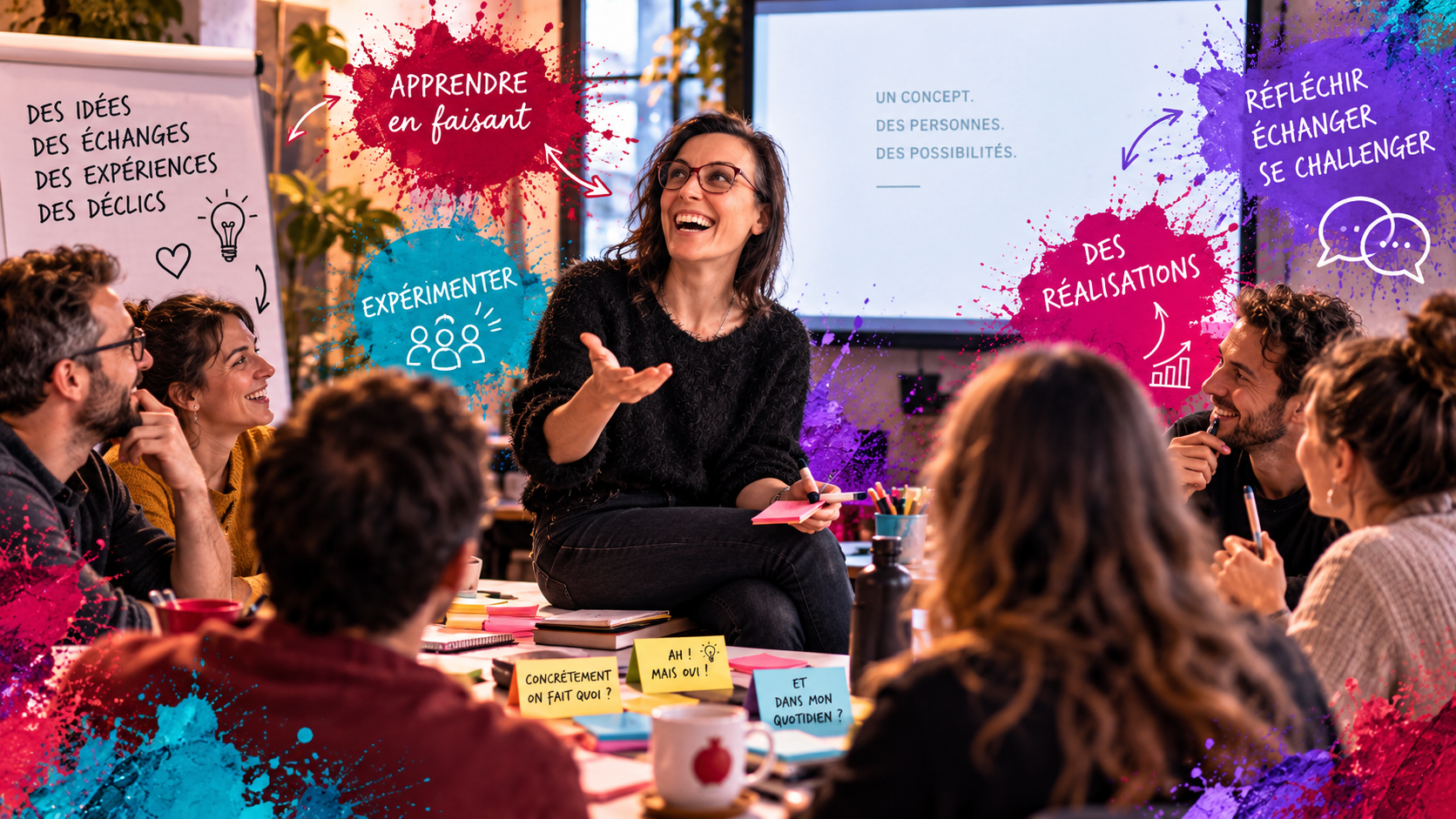
    Donnez-moi une petite assemblée, une table sur laquelle je peux m’asseoir pour discuter avec les participants, quelques feutres, un tableau, quelques post-it et un sujet le tout avec suffisamment de liberté pour construire une expérience pédagogique… et il y a fort à parier que je transformerai cela en sujet passionant parce que…

    En formation je suis chez moi.

    Parce que ce que j’aime dans la formation professionnelle, ce n’est pas tellement transmettre des informations.

    Des informations, nous en avons partout.

    Ce que j’aime, c’est voir le moment où elles deviennent compréhension.

    Ce petit :

    « Aaaaah… mais oui ! »

    Le moment où une personne comprend quelque chose sur elle-même, sur les autres, sur son métier ou sur une situation qu’elle rencontre depuis des années.

    Lorsque quelqu’un repart en comprenant mieux ce qui l’entoure et surtout en étant capable d’utiliser ce qu’iel vient d’apprendre, j’ai cette délicieuse impression de :

    « travail accompli. » 

    Une formation ne devrait pas consister à ingurgiter des informations

    Je vais probablement me faire quelques « amis » dans le milieu.

    Vous connaissez cette formation.

    9 h 03.

    PowerPoint.

    Slide n°1.

    Le formateur lit la slide.

    Slide n°2.

    Le formateur lit également la slide.

    À 10 h 17, votre âme a quitté votre corps mais votre présence physique reste obligatoire jusqu’à 17 h.

    J’ai connu ça aussi.

    Et déjà plus jeune, je supportais assez mal qu’on me demande simplement d’ingurgiter une information puis de la restituer.

    Parce qu’apprendre n’est pas seulement mémoriser. C’est comprendre. Questionner. Relier une nouvelle information à ce que nous savons déjà. L’expérimenter. La mettre à l’épreuve. Parfois même la contester.

    Une bonne formation devrait faire appel au discernement, à l’esprit critique et à la capacité de réflexion des participants.

    Sinon, autant envoyer le PDF. Parce qu’y participer sera aussi productive que de la lire en diagonale.

    Pédagogie active : rendre l’apprenant acteur de sa formation

    C’est pourquoi j’aime particulièrement les approches de pédagogie active et les formations participatives.

    Je peux apporter un concept, évidemment. L’expliquer. Le contextualiser. Donner les connaissances nécessaires pour le comprendre. Mais ensuite, j’ai envie qu’on en fasse quelque chose. Un exercice. Une expérience. Un jeu. Une discussion, voire un débat. Une étude de cas.Une résolution de problème. Une mise en situation. Un travail en petits groupes.

    Une situation volontairement exagérée pour pouvoir tester un comportement sans les conséquences qu’il aurait dans la vraie vie.

    Parce qu’il existe une énorme différence entre :

    « Je sais intellectuellement comment gérer un conflit. »

    et :

    « Je viens d’essayer de gérer un conflit. » (et ça s’est bien passé…) 

    C’est dans cet espace entre la connaissance et l’expérience que la formation devient vraiment intéressante.

    La mise en situation : expérimenter sans risquer de casser la machine

    Prenons justement la gestion des conflits en entreprise. (Une des formations que je pratique souvent pour mes clients, allez savoir pourquoi)

    On peut parfaitement consacrer deux heures à expliquer les mécanismes d’un conflit, les biais de perception, les différentes réactions possibles et les techniques de communication.

    Tout cela peut être utile.

    Mais ça reste de la théorie. Alors j’aime proposer des mises en situation.

    Et parfois des mises en situation volontairement extrêmes. Ou des espaces pour pratiquer l’erreur. 

    Parce qu’en exagérant un comportement, en jouant un rôle ou en poussant artificiellement une situation jusqu’à l’absurde, nous pouvons expérimenter. Essayer. Rater. Recommencer. Observer ce qui se passe. Ressayer quelque chose de plus audacieux ou personnel. Et rire. Le rire n’empêche pas l’apprentissage au contraire.

    Le rire peut créer un espace dans lequel on ose davantage essayer, se tromper et sortir de ses comportements habituels.

    On peut travailler sérieusement sans se prendre constamment au sérieux.

    Des ateliers pédagogiques qui créent aussi de la connexion

    C’est une autre chose que j’aime énormément dans la formation.

    Une salle de formation n’est pas uniquement composée d’individus venus acquérir une compétence.

    C’est aussi, temporairement, un groupe.

    Et ce groupe peut devenir une ressource pédagogique. Les uns, pour les autres.

    Un ice breaker bien conçu ne sert pas seulement à faire dire à quinze personnes leur prénom et leur animal préféré.

    Il peut créer immédiatement une dynamique.

    Faire apparaître des différences.

    Permettre aux participants de découvrir leurs collègues autrement.

    Faire émerger de la coopération.

    Créer suffisamment de sécurité pour que quelqu’un ose ensuite dire :

    « Je n’ai pas compris. »

    ou :

    « Je ne suis pas d’accord. »

    Et pédagogiquement, ces deux phrases valent de l’or !

    Parce qu’une formation dans laquelle personne ne questionne jamais rien n’est pas nécessairement une formation parfaitement comprise. C’est juste une salle beaucoup trop polie.

    Concevoir une formation sur mesure plutôt que plaquer une recette

    Je conçois également des formations et ateliers pédagogiques sur mesure.

    Et « sur mesure » ne signifie pas changer le logo sur la première slide.

    Cela signifie commencer par comprendre :

    Qui sont les participants ?

    Que savent-ils déjà ?

    Qu’est-ce qu’ils doivent réellement apprendre ?

    Dans quelles situations devront-ils utiliser ces connaissances ?

    Quels sont les objectifs pédagogiques ?

    Quelles sont les difficultés rencontrées ?

    Quelles compétences souhaite-t-on développer ?

    Quel est le temps disponible ?

    Qu’est-ce qui risque de les ennuyer ?

    Qu’est-ce qui risque au contraire de les mettre en difficulté ?

    Comment saura-t-on, à la fin, si quelque chose a réellement été acquis ?

    C’est de l’ingénierie pédagogique à une échelle très concrète : partir du besoin pour construire l’expérience d’apprentissage plutôt que partir d’un joli ensemble de slide et espérer très fort que quelque chose se passe.

    Votre formation existe déjà ? Parfait. On peut aussi la muscler.

    Et ça, c’est une partie de mon travail que j’aime particulièrement.

    Vous avez peut-être déjà ce que vous pensez être une excellente formation.

    Le contenu est pertinent. L’expertise est là. Mais…

    c’est un peu mou. Beaucoup de slides. Beaucoup de théorie. Beaucoup de temps passé à écouter. Et au bout d’une heure trente, vous observez ce regard très particulier chez les participants. Celui qui indique que leur corps se trouve toujours dans la salle mais que leur cerveau vient de partir acheter du pain.

    Je peux intervenir précisément là.

    Pas nécessairement pour refaire toute votre formation, rassurez-vous.

    Mais pour concevoir des activités pédagogiques qui viennent renforcer un contenu existant.

    Transformer vingt minutes de théorie en atelier inspirant. Créer une mise en situation. Imaginer un jeu permettant d’expérimenter un concept. Construire une étude de cas. Ajouter un exercice de réflexion individuelle. Faire travailler les participants ensemble. Créer une séquence permettant de vérifier ce qui vient réellement d’être compris.

    En somme :

    mettre du mouvement dans le contenu.

    Et pour une formation en ligne ?

    Même problème.

    Changer de support ne transforme pas miraculeusement un cours magistral en expérience pédagogique.

    Une formation en ligne peut être excellente, elle n’en est pas moins exigeante en terme de motivation à écouter et participer. Et les petits exercices pratique à faire, sont parfois plus paralysant qu’encourageant.

    Elle peut également devenir :

    vidéo 1, vidéo 2, Questionnaire. vidéo 3, quiz, félicitations, vous avez terminé.

    Et trois semaines plus tard :

    « C’était quoi déjà ? »

    Pour une formation e-learning, je peux donc également concevoir des exercices intermédiaires destinés à maintenir l’engagement et à consolider les apprentissages.

    Des questions de réflexion. Des cas pratiques. Des exercices d’application. Des défis entre deux modules. Des activités permettant de mobiliser une notion dans une situation réelle.

    Des outils d’évaluation des acquis. Des séquences permettant de revenir sur les connaissances précédentes.

    Parce que terminer une vidéo ne signifie pas nécessairement avoir appris quelque chose.

    La consommation d’un contenu n’est pas l’apprentissage de celui-ci.

    Consolider les apprentissages plutôt que simplement « valider la formation »

    Il existe d’ailleurs une différence qui me paraît fondamentale entre :

    avoir suivi une formation

    et

    avoir acquis une compétence.

    Une case cochée sur une plateforme LMS nous indique qu’une personne est arrivée jusqu’au bout d’un module.

    Elle ne nous dit pas nécessairement ce qu’elle saura faire lundi matin.

    J’aime donc travailler sur la consolidation des apprentissages.

    Faire revenir une notion.

    La présenter sous un autre angle.

    Demander de l’utiliser.

    Créer une difficulté nouvelle.

    Vérifier si la personne sait transférer ce qu’elle vient d’apprendre à une situation différente.

    Et surtout, permettre de se tromper.

    Parce que l’erreur en formation est formidable.

    Elle permet précisément de découvrir ce qui n’est pas encore compris avant que l’erreur coûte réellement quelque chose.

    Former aux relations humaines : un terrain particulièrement riche

    Mon domaine de prédilection reste évidemment celui des relations humaines.

    Communication.

    • Gestion des conflits.
    • Management.
    • Relations professionnelles.
    • Posture.
    • Compréhension des fonctionnements individuels.
    • Coopération.
    • Intelligence relationnelle.

    J’ai également conçu et animé des formations autour du Human Design, notamment avec des ateliers relationnels permettant aux participants de ne pas seulement découvrir leur profil mais d’expérimenter ce que ces différences peuvent produire dans leurs interactions.

    Et c’est là que mes différentes activités se rejoignent.

    Le coaching m’a appris à questionner.

    La formation m’oblige à structurer et transmettre.

    Mon travail sur les relations me permet d’observer ce qui se passe entre les participants, et pas seulement ce qui se trouve sur mon programme pédagogique.

    La meilleure formation est peut-être celle où le formateur parle moins

    Cela peut sembler paradoxal lorsqu’on vend de la formation.

    Mais je n’ai aucune envie d’être la personne qui se fait mousser pendant sept heures.

    Mon rôle consiste aussi à créer les conditions permettant aux participants de réfléchir eux-mêmes.

    Je peux apporter une expertise.

    Je peux construire le cadre.

    Je peux challenger une réponse.

    Ajouter une information.

    Mettre deux idées en contradiction.

    Faire remarquer quelque chose qui vient de se produire dans le groupe.

    Mais les participants arrivent eux aussi avec leurs expériences, leurs compétences, leurs désaccords et leurs questions.

    Pourquoi gaspiller cette richesse en leur demandant simplement de se taire et de m’écouter ?

    Former n’est pas remplir des têtes. C’est créer les conditions pour que quelque chose se construise dedans.

    Et parfois entre elles.

    Pourquoi je fais de la formation ?

    Finalement, pour ce moment-là.

    Celui où quelqu’un s’arrête.

    Réfléchit.

    Et dit :

    « Attends… je viens de comprendre quelque chose. »

    J’adore cet instant.

    Parce qu’une information vient de changer de statut.

    Elle n’est plus simplement quelque chose que j’ai dit.

    Elle appartient désormais à la personne qui vient de la comprendre.

    Et lorsqu’un atelier a permis en plus à plusieurs personnes de rire ensemble, de mieux se comprendre, de tester quelque chose qu’elles n’auraient jamais osé essayer dans leur environnement professionnel et de repartir avec une compétence réellement utilisable…

    Oui.

    Là, j’ai l’impression d’avoir fait mon boulot.

    Vous cherchez une formation professionnelle ou un atelier sur mesure ?

    Je peux intervenir de plusieurs manières :

    • concevoir et animer une formation professionnelle sur mesure ;
    • créer un atelier pédagogique ou participatif autour d’une problématique précise ;
    • intervenir ponctuellement dans un séminaire ou une formation existante ;
    • concevoir un ice breaker qui ait une véritable fonction plutôt qu’un simple effet d’animation ;
    • créer des jeux, études de cas et mises en situation professionnelles ;
    • enrichir une formation existante avec des activités de pédagogie active ;
    • concevoir des exercices pour une formation en ligne ou e-learning afin de favoriser l’assiduité, l’engagement et la consolidation des acquis ;
    • travailler autour de la communication, du management, de la coopération, des relations humaines ou de la gestion des conflits en entreprise.

    Vous avez déjà le contenu mais il lui manque l’expérience pédagogique ? Ça m’intéresse aussi. Sans ajouter 50 slides supplémentaires, rassurez-vous, ensemble, on peut très largement faire que quelque chose se passe dans la salle.

  • Bespoke professional training: learn, experiment… and even have fun

    Bespoke professional training: learn, experiment… and even have fun

    I have probably never felt quite as at home as I do in a training room.

    Give me a small group, a table I can sit on while talking with participants, a few markers, a whiteboard, some Post-it notes and a topic, with enough freedom to build a learning experience… and there is a very good chance I will turn it into something fascinating because…

    Training is where I feel at home.

    Because what I love about professional training is not so much passing on information.

    Information is everywhere.

    What I love is seeing the moment when it becomes understanding.

    That little:

    “Aaaaah… yes, of course!”

    The moment when someone understands something about themselves, about other people, about their work or about a situation they have been dealing with for years.

    When someone leaves with a better understanding of what surrounds them and, above all, able to use what they have just learned, I get that delicious feeling of:

    “job done.”

    Training should not be about swallowing information

    I am probably going to make a few “friends” in the industry with this one.

    You know that training course.

    9:03 a.m.

    PowerPoint.

    Slide no. 1.

    The trainer reads the slide.

    Slide no. 2.

    The trainer reads that one too.

    By 10:17 a.m., your soul has left your body, but your physical presence remains compulsory until 5 p.m.

    I have been there too.

    Even when I was younger, I had very little patience for being asked simply to absorb information and then reproduce it.

    Because learning is not just memorising. It is understanding. Questioning. Connecting new information to what we already know. Experiencing it. Testing it. Sometimes even challenging it.

    Good training should call on participants’ judgement, critical thinking and ability to reflect.

    Otherwise, you might as well send the PDF. Attending will be about as productive as skimming it.

    Active learning: making learners active participants in their training

    That is why I particularly enjoy active learning approaches and participatory training.

    I can introduce a concept, of course. Explain it. Put it into context. Provide the knowledge needed to understand it. But then I want us to do something with it. An exercise. An experiment. A game. A discussion, perhaps even a debate. A case study. A problem to solve. A role-play. Small-group work.

    A deliberately exaggerated situation in which people can test a behaviour without facing the consequences it might have in real life.

    Because there is an enormous difference between:

    “I know intellectually how to manage a conflict.”

    and:

    “I have just tried to manage a conflict.” (and it went well…)

    It is in that space between knowledge and experience that training becomes truly interesting.

    Role-play: experimenting without risking breaking the machine

    Take conflict management in the workplace, for example. (One of the training topics I often work on with clients. I wonder why.)

    We could quite easily spend two hours explaining the mechanics of conflict, perception biases, possible reactions and communication techniques.

    All of that can be useful.

    But it is still theory. So I like to introduce role-play and practical scenarios.

    Sometimes deliberately extreme ones. Or spaces where people can practise making mistakes.

    By exaggerating a behaviour, playing a role or deliberately pushing a situation towards the absurd, we can experiment. Try. Fail. Start again. Observe what happens. Try something more daring or more personal. And laugh. Laughter does not prevent learning. Quite the opposite.

    Laughter can create a space in which we dare to try more, make mistakes and step outside our usual patterns.

    We can work seriously without taking ourselves seriously all the time.

    Learning workshops that also create connection

    That is another thing I love about training.

    A training room is not simply a collection of individuals who have come to acquire a skill.

    For a while, it is also a group.

    And that group can become a learning resource for its members.

    A well-designed icebreaker is not just a way of making fifteen people say their name and favourite animal.

    It can immediately create a dynamic.

    Reveal differences.

    Allow participants to discover their colleagues in a different way.

    Encourage cooperation.

    Create enough psychological safety for someone to dare to say:

    “I didn’t understand.”

    or:

    “I disagree.”

    From a learning perspective, those two sentences are worth their weight in gold.

    Because a training session where nobody ever questions anything is not necessarily a training session everyone has perfectly understood. It may simply be a room that is far too polite.

    Designing bespoke training instead of applying a ready-made formula

    I also design bespoke training programmes and learning workshops.

    And “bespoke” does not mean changing the logo on the first slide.

    It means starting by understanding:

    Who are the participants?

    What do they already know?

    What do they actually need to learn?

    In what situations will they need to use this knowledge?

    What are the learning objectives?

    What difficulties are they encountering?

    What skills do we want to develop?

    How much time is available?

    What is likely to bore them?

    What, on the contrary, might put them in difficulty?

    How will we know, at the end, whether something has actually been learned?

    This is instructional design at a very practical level: starting with the need and building the learning experience around it, rather than starting with a nice set of slides and hoping very hard that something happens.

    Already have a training programme? Perfect. We can strengthen it too.

    And this is a part of my work that I particularly enjoy.

    You may already have what you believe is an excellent training programme.

    The content is relevant. The expertise is there. But…

    it is a little flat. Lots of slides. Lots of theory. Lots of time spent listening. And after an hour and a half, you notice that very particular look on the participants’ faces. The one that tells you their bodies are still in the room, but their brains have gone out to buy bread.

    That is precisely where I can step in.

    Not necessarily to rebuild your entire training programme, don’t worry.

    But to design learning activities that strengthen existing content.

    Turn twenty minutes of theory into an inspiring workshop. Create a practical scenario. Imagine a game that lets people experience a concept. Build a case study. Add an individual reflection exercise. Get participants working together. Create a sequence that checks what has actually been understood.

    In short:

    put some movement into the content.

    What about online training?

    Same problem.

    Changing the medium does not magically transform a lecture into a learning experience.

    Online training can be excellent, but it still demands motivation to listen and participate. And those little practical exercises people are asked to complete can sometimes feel more paralysing than encouraging.

    It can also become:

    video 1, video 2, questionnaire, video 3, quiz, congratulations, you have finished.

    And three weeks later:

    “What was that about again?”

    For e-learning, I can therefore also design intermediate exercises intended to maintain engagement and consolidate learning.

    Reflection questions. Practical cases. Application exercises. Challenges between two modules. Activities that require learners to use a concept in a real situation.

    Tools for assessing learning outcomes. Sequences that revisit previous knowledge.

    Because finishing a video does not necessarily mean you have learned something.

    Consuming content is not the same as learning it.

    Consolidating learning rather than simply “completing the course”

    There is a distinction that seems fundamental to me between:

    having attended a training course

    and

    having acquired a skill.

    A ticked box on an LMS platform tells us that someone reached the end of a module.

    It does not necessarily tell us what they will know how to do on Monday morning.

    So I like working on learning consolidation.

    Bring a concept back.

    Present it from another angle.

    Ask people to use it.

    Introduce a new difficulty.

    Check whether someone can transfer what they have just learned to a different situation.

    And, above all, allow people to make mistakes.

    Because mistakes in training are wonderful.

    They allow us to discover precisely what has not yet been understood before the mistake actually costs something.

    Training in human relationships: an especially rich field

    My favourite field remains, of course, human relationships.

    Communication.

    • Conflict management.
    • Management.
    • Workplace relationships.
    • Professional stance.
    • Understanding individual ways of functioning.
    • Cooperation.
    • Relational intelligence.

    I have also designed and facilitated training around Human Design, including relational workshops that allow participants not only to discover their profile but also to experience what these differences can produce in their interactions.

    And this is where my different activities come together.

    Coaching has taught me how to ask questions.

    Training forces me to structure and communicate.

    My work on relationships allows me to observe what happens between participants, not only what is written in my training programme.

    The best training may be the one where the trainer talks less

    That may sound paradoxical when you sell training.

    But I have no desire to be the person showing off for seven hours.

    My role is also to create the conditions that allow participants to think for themselves.

    I can bring expertise.

    I can create the framework.

    I can challenge an answer.

    Add information.

    Put two ideas into conflict.

    Point out something that has just happened within the group.

    But participants also arrive with their own experiences, skills, disagreements and questions.

    Why waste all that richness by simply asking them to shut up and listen to me?

    Training is not about filling heads. It is about creating the conditions for something to be built inside them.

    And sometimes between them.

    Why do I train people?

    Ultimately, for that moment.

    The one when someone stops.

    Thinks.

    And says:

    “Wait… I’ve just understood something.”

    I love that moment.

    Because a piece of information has just changed status.

    It is no longer simply something I said.

    It now belongs to the person who has understood it.

    And when a workshop has also allowed several people to laugh together, understand each other better, test something they would never have dared to try in their professional environment and leave with a skill they can genuinely use…

    Yes.

    That is when I feel I have done my job.

    Looking for professional training or a bespoke workshop?

    I can work with you in several ways:

    • design and deliver bespoke professional training;
    • create a learning or participatory workshop around a specific issue;
    • contribute to an existing seminar or training programme;
    • design an icebreaker with a genuine purpose rather than simply an entertainment effect;
    • create games, case studies and professional role-play scenarios;
    • enrich an existing training programme with active learning activities;
    • design exercises for online training or e-learning to support attendance, engagement and consolidation of learning;
    • work on communication, management, cooperation, human relationships or conflict management in the workplace.

    Already have the content but it lacks the learning experience? I am interested in that too. Without adding another 50 slides, don’t worry: together, we can absolutely make sure that something happens in the room.