Have you noticed how personal development can give the impression that there is an astonishing number of instructions telling us how to become better human beings?
Be more disciplined. More spontaneous. Learn to say no. Get out of your comfort zone. Persevere. Let go. Think before you act. Stop overthinking.
In short: do everything and its opposite, but please do all of it properly!
And when it does not work, we have an unfortunate tendency to draw a rather brutal conclusion:
“The problem is me.”
That is precisely where I like to use Human Design in coaching.
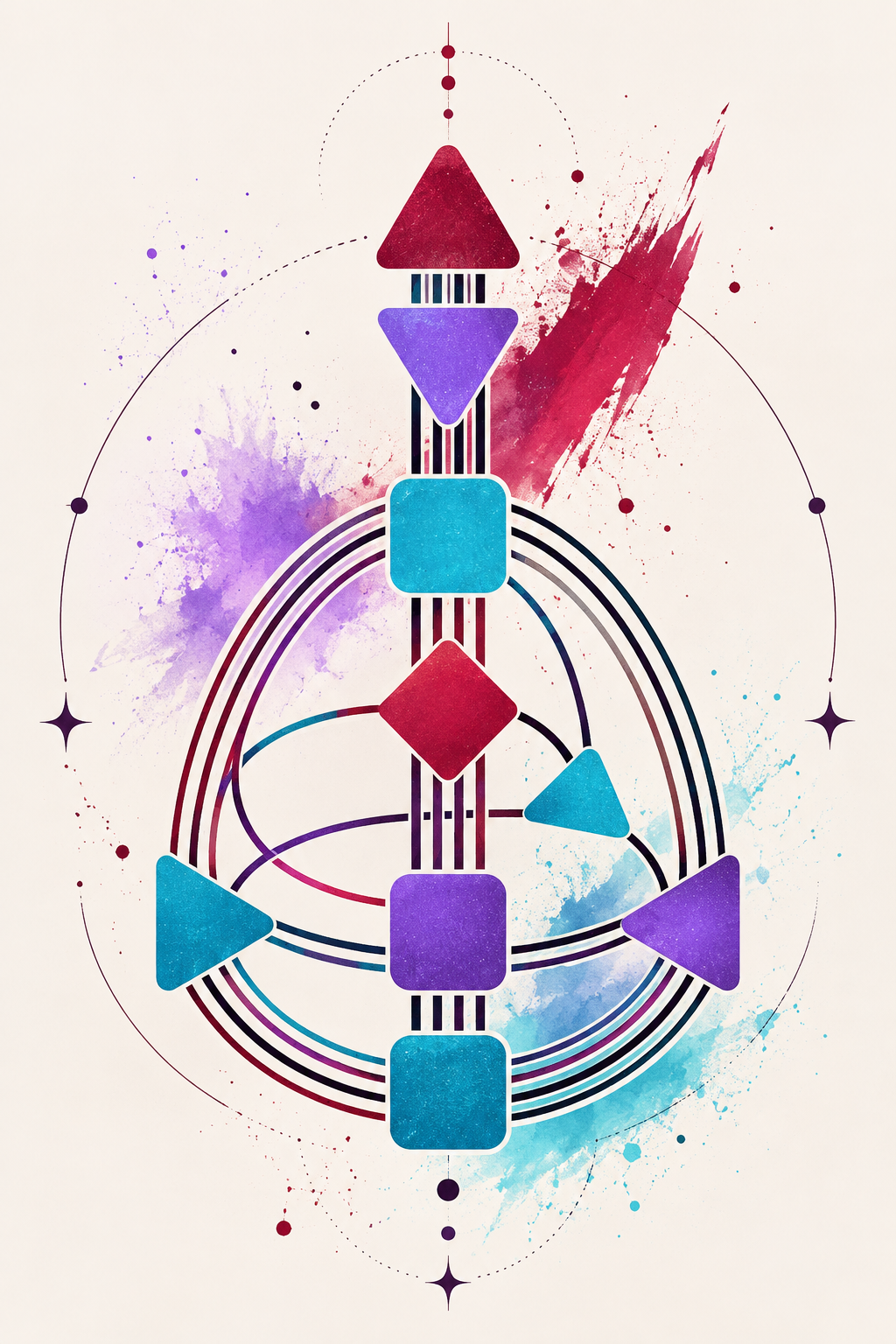
Not as absolute truth, a crystal ball or random determinism… and certainly not to tell someone who they are by showing them a pretty coloured diagram as though they had finally found the owner’s manual that went missing at birth.
I use it as one more tool for asking better questions, exploring potential and, above all, learning to like ourselves a little better.
What exactly is Human Design?
 Human Design is an individual reading system created in the late 1980s by Alan Robert Krakower, who later adopted the self-proclaimed name Ra Uru Hu.
It combines elements drawn from several traditions and systems, including astrology, the I Ching, the Kabbalah and the chakra system, with a vocabulary that also borrows from contemporary science.
Let us be clear: Human Design is not a scientifically validated psychological or medical model.
I do not use it to diagnose anything, nor to explain a person’s biology, health or psychology as though the chart constituted scientific evidence.
I use it as a symbolic framework for reflection.
A framework can be useful even when it is not a scientific theory, provided we remain very clear about what we are doing with it.
Why use Human Design in coaching?
Because sometimes we have spent years trying to function according to rules that suit us rather badly.
Take energy, for example.
We are often told that if we are motivated enough, organised enough and disciplined enough, we should be capable of maintaining roughly the same pace as everyone else.
Human Design proposes another way of questioning that assumption.
Not:
“Why can’t I keep up?”
but perhaps:
“Where does my energy actually create the most value?”
That question does not magically prove anything about your physiology.
But it can lead to very concrete observations about your working rhythm, your environment, the tasks that drain you, the ones that stimulate you, and the situations in which your contribution is most relevant.
And sometimes that is enough to stop treating every difference as a defect.
The five Human Design types as hypotheses, not boxes
Human Design distinguishes five major types: Generator, Manifesting Generator, Projector, Manifestor and Reflector.
Each comes with its own language about strategy, energy and interaction.
The temptation is obvious:
“Aha! I am a Projector, therefore I am like this.”
No.
Or at least, not in the way I use the tool.
I would rather ask:
“Does this description help you notice something real in your experience?”
If yes, let us explore it.
If no, we do not need to twist reality until it fits the chart.
A useful tool should help us observe ourselves better.
It should not force us to become loyal to the tool.
Human Design and self-acceptance
This is probably the part that interests me most.
Many people arrive in coaching with a long list of things they believe they should correct about themselves.
Too slow.
Too intense.
Too sensitive.
Too independent.
Too indecisive.
Too impatient.
Not productive enough.
Not sociable enough.
Not ambitious enough.
Too ambitious.
Human Design can sometimes offer a sufficiently different perspective to interrupt that automatic judgement.
What if the question were not:
“How do I become more normal?”
but:
“How does this characteristic actually work in me, and what do I do with it?”
That does not mean romanticising every difficulty.
Some behaviours need to change.
Some skills need to be learned.
Some habits are genuinely harmful.
But self-acceptance and change are not opposites.
Sometimes we change much more effectively once we stop spending half our energy insulting ourselves for being the person who needs to change.
Human Design in relationships: what if the other person were not a bad version of you?
This is another area where I find the framework particularly interesting.
We constantly interpret other people through our own way of functioning.
“When I care about someone, I do this.”
Therefore:
“If they don’t do it, they can’t really care about me.”
And that is how two perfectly legitimate ways of functioning can manufacture a monumental conflict out of almost nothing.
In a couple, a family or at work, Human Design can offer another lens:
What if the other person were not a bad version of me?
That simple question can be extremely powerful.
Not to excuse any behaviour whatsoever because a coloured chart supposedly decided it.
But to distinguish between:
a difference in functioning, a difference in needs, and genuinely problematic behaviour.
Those are really not the same thing.
Where I refuse to use Human Design
There is, however, one boundary I care about very much.
I never want to hear:
“I’m like this because I’m a Projector.”
Or:
“He’s a Manifestor, so of course he does that.”
No.
Your Human Design is not an official medical certificate of being a pain in the arse.
It does not exempt you from responsibility, learning or self-questioning.
Quite the opposite.
If a framework helps you understand a mechanism better, it should increase your ability to act on it, not provide an excellent excuse for never changing anything again.
So why use Human Design in coaching?
Because sometimes we have spent years trying to solve the wrong problem.
And a sufficiently different framework can provoke something valuable:
“Wait… what if I looked at this differently?”
That is what I am looking for.
I work with different tools because no single tool can summarise a human being.
Not Human Design.
Not a personality test.
Not a psychological theory.
Not even your own story about yourself.
But each can illuminate a different part of the problem.
And sometimes a single new hypothesis is enough for something that has felt stuck for years to finally begin moving.
That is why I use Human Design alongside coaching.
Not to tell you who you are.
But to have one more way of asking you:
“What if you simply do not function the way you were taught you should?”